Category: DOD (Page 3 of 3)

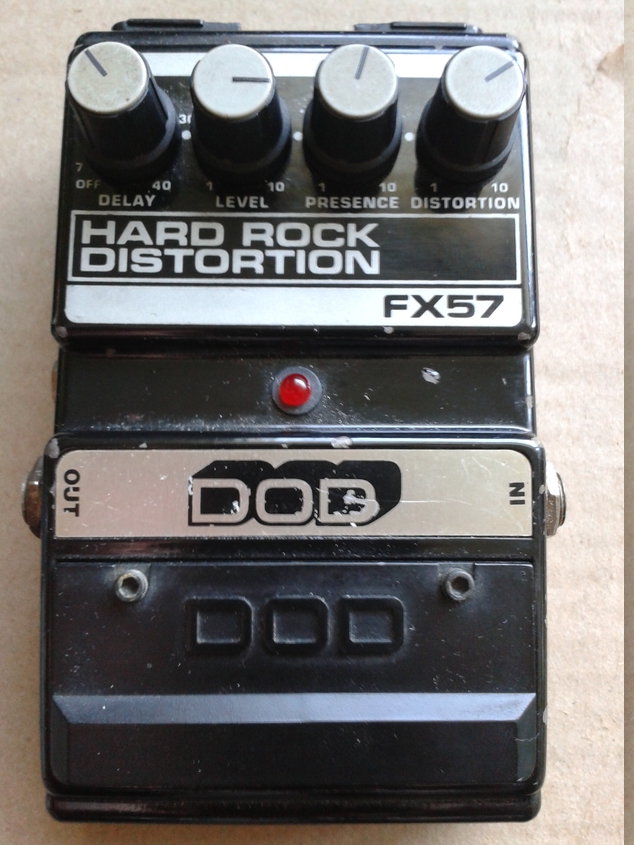
DOD FX57 Hard Rock Distortion

DOD-FX57-HardRockDist

What is it?
DOD FX57 Hard Rock Distortion. USA made box, dating 1987.

Bad year. 1987 i mean. According to DOD information heaven, America’s Pedal website, the basic idea for this design was already tried out on certain DigiTech double pedal, as well as on one Boss design. And what is this idea? To take a OD/Distortion and place a delay circuitry after it to “widen” or “thicken” the sound. I must say that the idea itself doesn’t sound that bad. Distortion with analog delay? How could that be bad? Well it can. For those interested, the schematic can be found online at Schematics Unlimited. It shows that the delay section is placed  after the main gain stage and to be mixed back to the distorted signal at the level control. The delay itself is created with MN3007/NM3101 pair. Level control is mixing the signal, delay included or not, with virtual ground and passing it to the presence control. The distortion control is basically just a variable resistor limiting the input signal current after the mandatory input buffer – which is needed due to basic DOD electronic switching. There are two trimmers that affect the delay functionality.

DOD-FX57-HardRockDist-Guts

The board looks kinda cool with those yellow mylar caps.

Now what exactly makes this a bad design? Two things. The distortion and the controls. That is a lot for one design. With the soft clipping, placing four Si diodes to the feedback loop of the gain stage offers something that isn’t too far from tube screamers, but the filters and second clipping stage (the Ge diodes) before the volume control gives out texture that isn’t too desirable. And that presence control would need a huge rework to even remind me of anything reasonable.  I personally think that presence is just a wrong word for this control. It should rather be “extreme bass cut pot that we here at DOD didn’t think all the way through”.

How does it sound?
Bad. Thin, hollow and nasal. Turning the delay off doesn’t quite help you. With the distortion at minimum and delay maxed, we can get something that reminds one of usable sound. But it is pretty crappy sounding design. Not all the settings are awful, but none of them are particularly good wither. Overall experience is so crappy, that i have high hopes for this becoming a rare gem – due to low(ish) number of units manufactured in relatively short period and the fact that some people will dispose their units with their everyday garbage. Which wouldn’t be too crazy idea with this particular unit. Not all of the setting combinations are horrible, but in genereal; it sucks and it sucks hard. But it is an interesting failure.

DOD FX52 Classic Fuzz

DOD-FX52-ClassicFuzz.resized What is it?
DOD FX52 Classic Fuzz, Made in USA in early to mid 90s. Yup. It seems almost like yesterday when boxes of this series were in every young guitarists hands. It’s been 20 years already, but i wouldn’t exactly call it “vintage” for another two decades though.

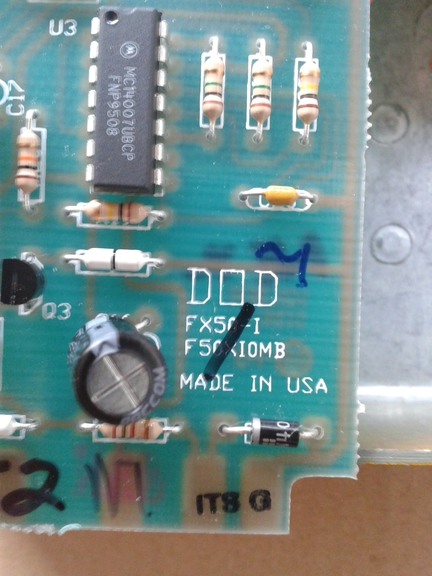
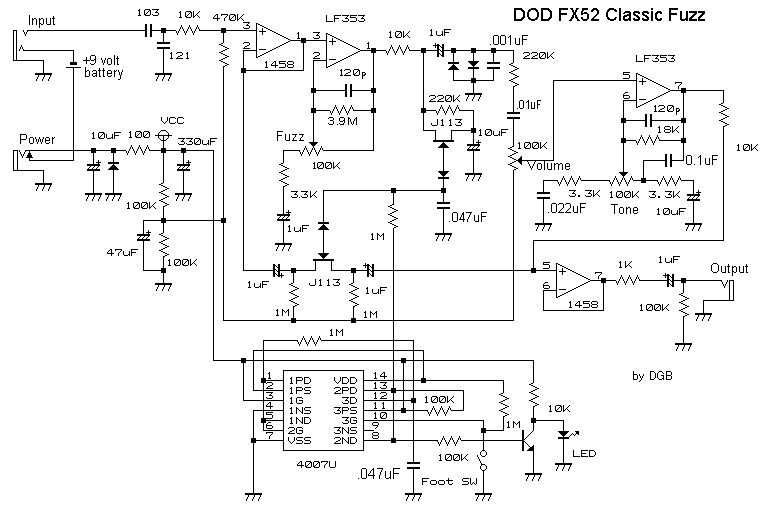
This model was discontinued in 1998, and my units serial number points to manufacture date being close to first quarter of 1994. It’s not a perfect pedal in any way. The most interesting thing is that this one has the same PCB as FX50. Only a few component values differ and one clipping stage is omitted. There’s a lot of good info available on this circuit on the America’s Pedal site. You can find the schematic hosted at Experimentalists Anonymous, if you want to see it. Schematic shows a few things one would want to mod. Not going into that right now – as i would need another unit in my collection before i would dare to ravage one of these. Things i would do to her would be; adding a diode pair to the feedback loop of LF353, tuning/upping the gain on the tone driver half of that IC and probably doubling the hard clipping diodes and removing the 1n cap taming it. One could also tune the 22n and 10µ caps to their taste of tone control. Maybe even rethink some pot values and tapers.

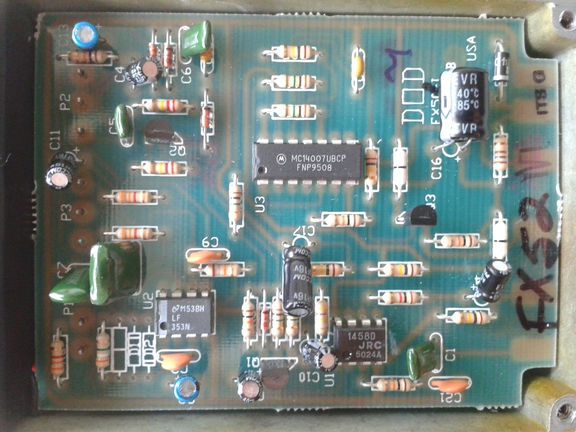
DOD-FX52-ClassicFuzz-Guts1.resized

Chips not affiliated with bypass switching are LF353 for the gain and tone stages and JRC1458 as in and out buffers. Also. Note the unconnected components left from LF353. As you can see from the shot above, the model is marked on the board with permanent marker. Here’s another photo that shows what’s under the filter cap:

DOD-FX52-ClassicFuzz-Guts4.resized

So it’s built on FX50 PCB. According to internet, it seems that there are other models sharing the same board too.

How does it sound?
To be honest. I’ve heard a lot of better circuit designs. Where DOD advertised this with the spiel “The FX52 Classic Fuzz duplicates the sound of the early 60s distortion boxes, such as the Fuzz Face and the Fuzz Tone. A must for musicians looking for a more nostalgic sound.” – I Do not find the resemblence to Maestro or Arbiter fuzzes mentioned. It’s more compressed than Big Muff, while that would be the closest vintage circuit. I still can’t hear the Fuzz in there. It’s much closer to being just muddy distortion than a real Classic fuzz. It has decent output level and better-than-average sustain. Might keep it in my collection, just in case. But i don’t see myself fastening this to my pedal board anytime soon. Or maybe i should mod it after all…  Good thing you can get still these for cheap, at least at the time of writing.

Newer posts »

© 2025 killall -9 humans

Theme by Anders NorenUp ↑