Author: mirosol (Page 14 of 29)

Boss PSM-5 Power Supply & Master Switch

Boss-PSM5

What is it?
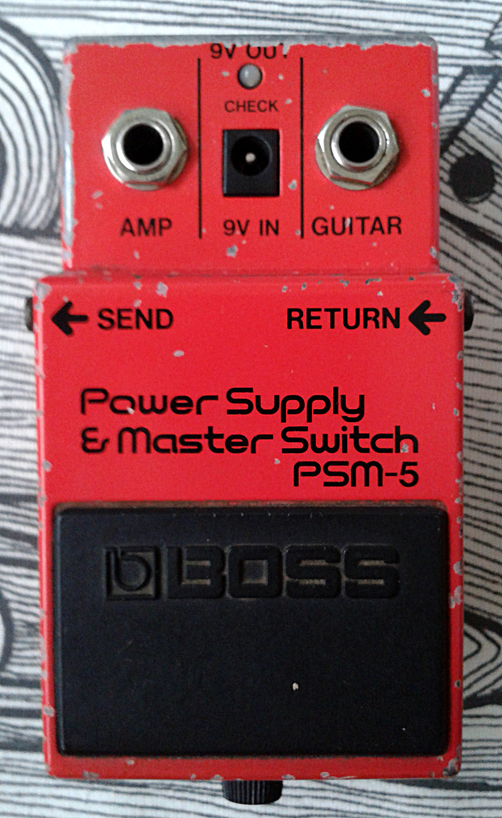
Boss PSM-5 Power Supplu & Master Switch. Made in japan, november 1982.

There has been a time place for everything. Daisy chaining, or dedicated power supplies were both practically unheard of until this new and exciting device hit the market. What surprises me more is that the pedal was actively sold from 1983 all the way until 1999. I thought the interest for the features offered would have been way gone by 1999. This unit has seen use and it has the orginal black label on its bottom. The label explains the main features as well.
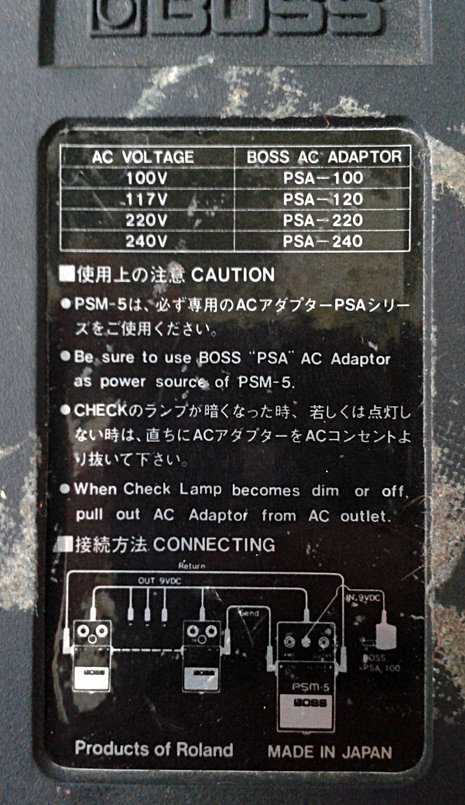
Boss-PSM5-back

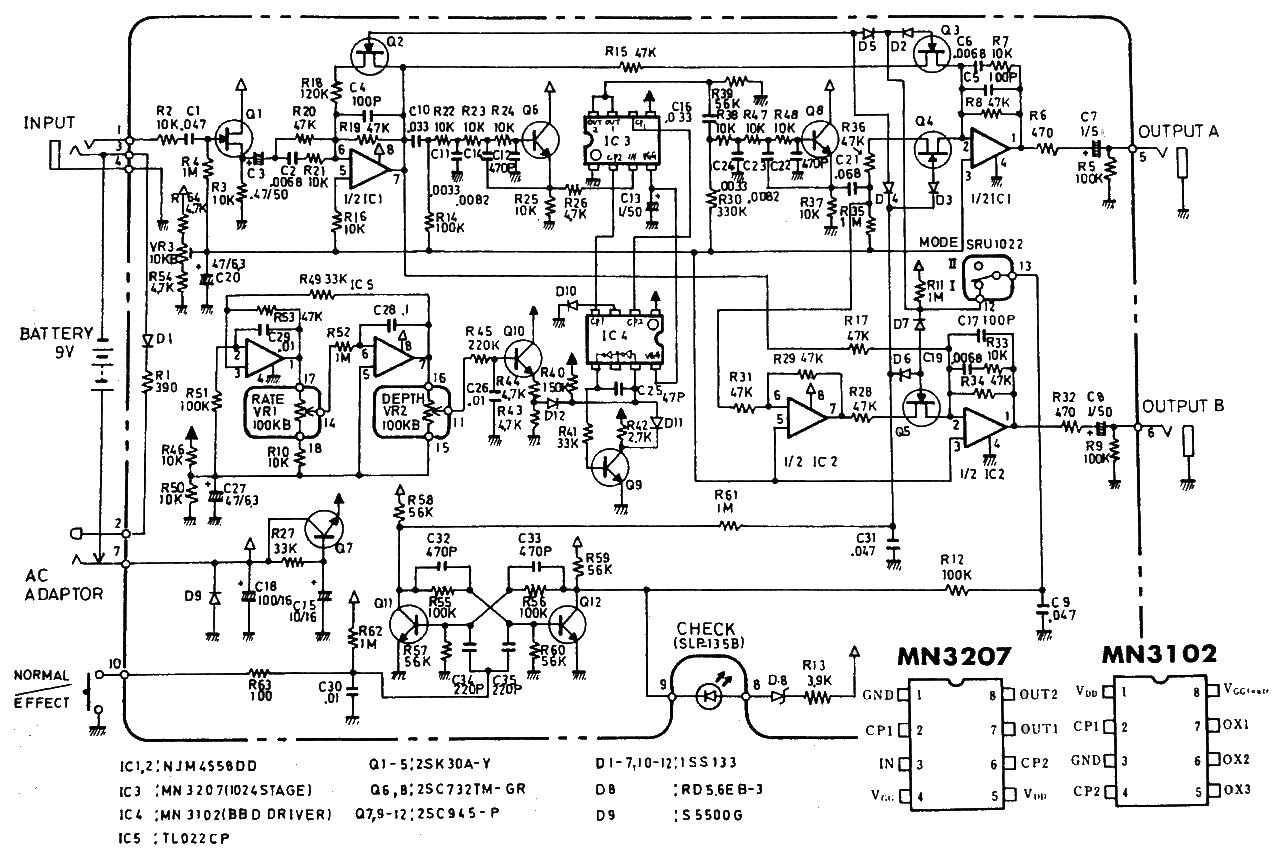
The nice looking old school style board houses the boss standard flip-flop switching and an effect loop (’cause that’s what the pedal actually does). These were originally shipped with a power supply and a splitter cable for up to seven effects. Since my specimen is from the year 1982, you can take a guess if either of those have survived. Quick search produced a schematic, which confirms that the design for the loop is simply four buffers, controlled by electronic switching – an effect loop if you will. Schamatic also shows that the power supply is only splitted for the out going 9VDC.
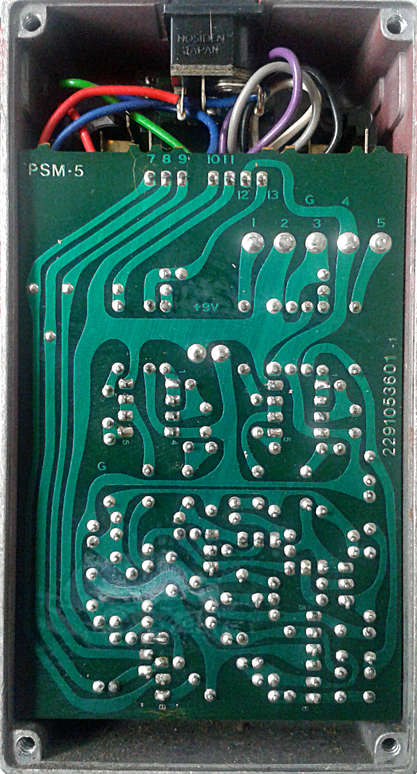
Boss-PSM5-guts1

One other thing noted in the schematic. The operational amplifiers should be NJM4558DD, or in other words the classic JRC4558D. Seeme like mine has been modded at some point in the pedal’s life. The ICs have been removed and replaced by sockets, which now have two LF353s, high grade audio chips in them. Rest of the semiconductors seen on the board are two BJTs for the flip-flop, another two BJTs for LED control and four JFETs to take care of the actual switching of the loop.

Boss-PSM5-guts2

These older Boss boards are mostly a pleasure to look at. Acid trip traces but annoying lack of symmetry. Plus an acre of free land to grow your tomatoes.

How does it sound?
It works as an effects loop, so it should not have a sound of its own. And furthermore, it doesn’t. I do understand why someone wanted to swap the opamps for “better” ones, but as they are acting only as an unity amplifiers (or we could say buffers), i strongly feel the improvement in sound is next to nothing. This being there’s not much i can say about how it sounds. It is a relic, which makes it rather interesting.

I do believe this had lots and lots of user value back in eighties and in the beginning of 90s. Using one now? Not a chance. There are tiny hardwired true bypass loopers and extremely high quality standalone buffers in existence, so at least for me, the choice would be very simple and clear.
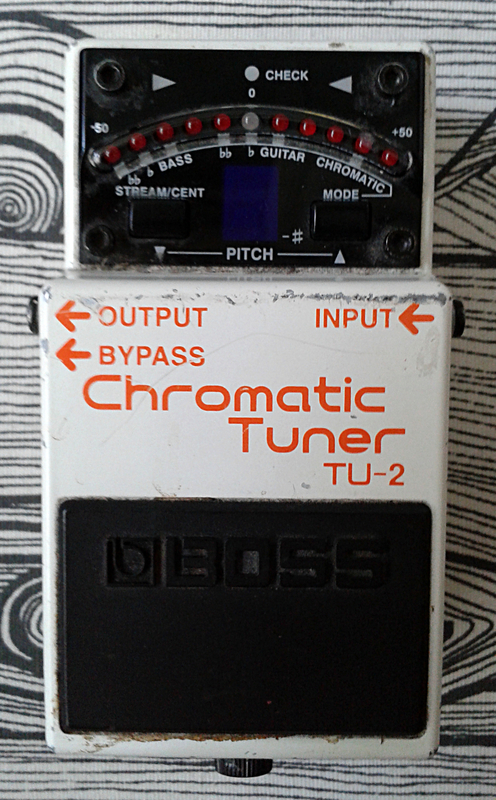
Boss TU-2 Chromatic Tuner

Boss-TU2

What is it?
Boss TU-2 Chromatic Tuner from compact series. Made in taiwan, june 2004

The workhorse. I’ve heard stories that these nearly didn’t make it to production at all, since the designers were sure that there would be no market for a pedal tuner. Well. I do get it. After all, the Arion and DOD had flopped pretty hard with theirs. But the TU-2 made it to production and if i’m not completely wong, it sold very well. So well that Bossarea page calls it an instant hit.

Boss-TU2-guts1

There are different tuning modes as features, but i must confess that i’ve never used any of those. Not even to try them out. The standard chromatic mode that picks up the note you play has been sufficient. For years.

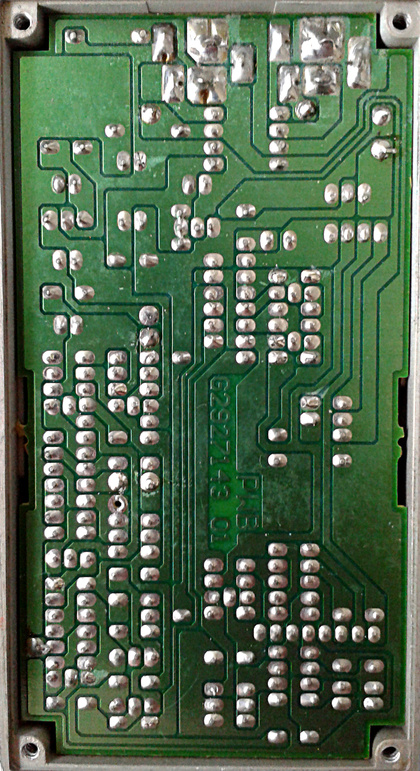
Pedal is made of two separate boards, a mix of digital and analog circuitry. Nothing too eye pleasing with autorouted, tasteless and scentless feel to overall construction.

Boss-TU2-guts2

But then again, who buys a hammer for its looks? Metaphor for a hammer isn’t as far as you would think. As you probably have seen, there are pink and tiny designer hammers in existence, but no one in their right mind would pick up one of those if they were to build a proper wooden wall. No. They would pickup that old, rusty heavy thing that is a real hammer.

Boss-TU2-guts3

Boss TU-2 is (or was) a hit for several reasons. User can see the display on the darkest stage without disturbance, the accuracy is good enough and.. Well. It simply gets the job done. TU-2 got discontinued due to TU-3, which has more features and, i believe, is aimed to take on TC Electronics tuners in the market, which consequently have even more features. Come what may, the TU-2 will stay and enjoy its cult status. Less features sometimes mean higher usability.

How does it sound?
As most of the Boss pedals tend to drain your signal when bypassed, the buffering on TU-2 is either better than on the rest, or i may be turning def. While this tuner doesn’t sound like anything per se, it acts a faithful buffer when it’s turned off. As a tuner, this unit is something that all other pedal tuner manufacturers should take a look at. It works.

Boss HM-3 Hyper Metal

Boss-HM3

What is it?
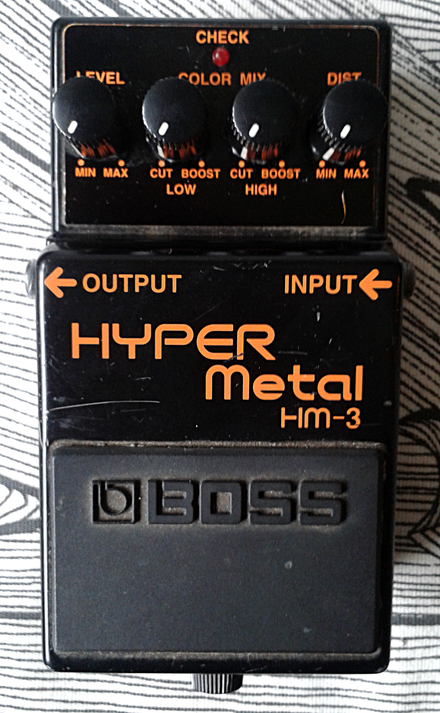
Boss HM-3 Hyper Metal from Boss Compact series. Made in taiwan, march 1993.

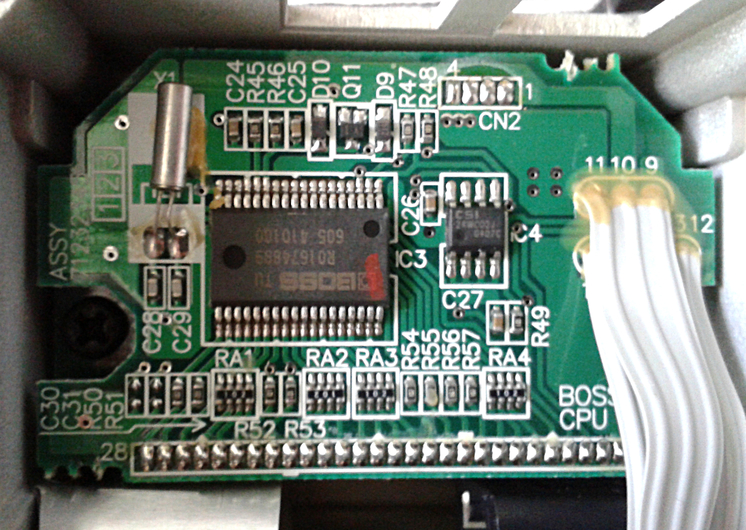
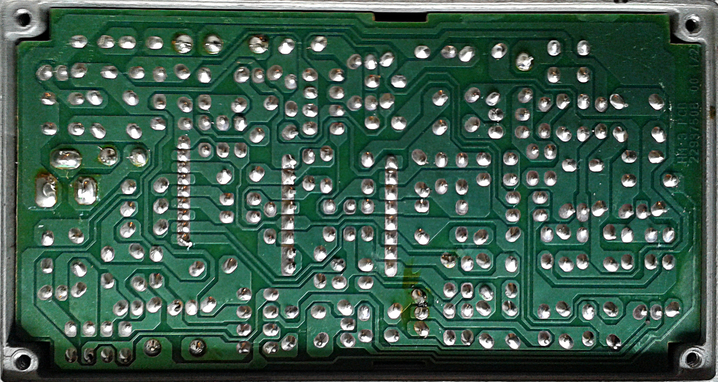
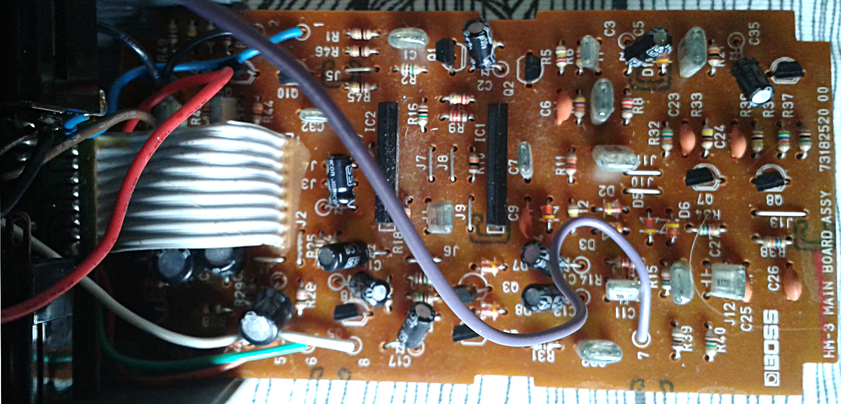
The younger brother of since discontinued HM-2. Similar controls and expectance for similar sounds was high to say at least. This time there is some symmetry on the board design and even those machine like autorouted traces do not bother me that much. Not exactly sure how accurate the schematic up at FIS is, but i’m thinking the base topology is correct. So we have a design that’s somewhat close to HM-2, with the triple gyrator EQ tha has two controls and three separate clipper stages.

Boss-HM3-guts1

As usual for many Boss boards, the opamps are SIP devices. The asymmetrical clipping amp with distortion control is made of one opamp channel and NPN/PNP transistor pair. Still quite similar to the HM-2. In build quality and and housing issues, this doesn’t stand out of Boss Compact crowd. Solid, but dull.

Boss-HM3-guts2

All of the features feel a lot like HM-2 Heavy Metal, but power supply requirements are updated to be more modern and well..

How does it sound?
Actually better than the praised older brother. To my ears the distortion is slightly thicker, fatter and lows feel even more crushing with its soaring highs. The overall tone manages to stay quite defined even thought the amount of distortion is impressive. If i was to use metal distortion on my board, this would most likely be it.

Boss HF-2 Hi-Band Flanger

Boss-HF2

What is it?
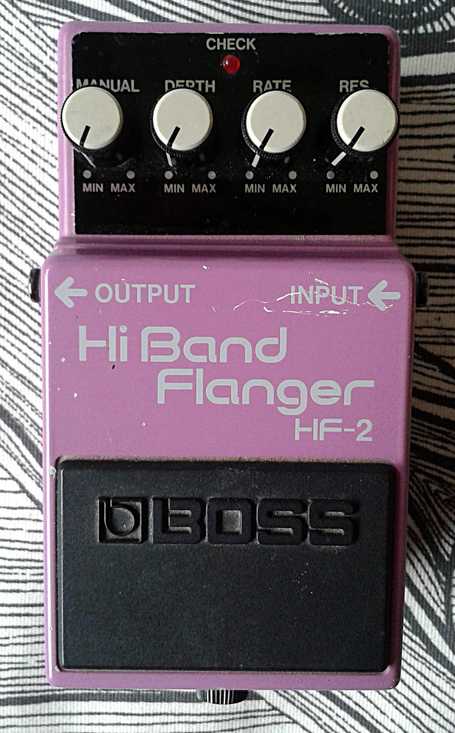
Boss HF-2 HiBand Flanger from compact series. Made in japan, august 1988.

Japan made HF-2 is probably the most praised flanger, not only in Boss catalog, but otherwise too. While the “standard” Boss flanger may be and have been the BF-2 for decades, the HF-2 operates in slightly different manner. While most flangers mix the whole incoming signal with delayed duplicate (controlled by LFO to create the sweep), this Hi Band Flanger takes the incoming signal and splits it in two ways. Other stays as it is and the other is pushed to up octave which then has the flanging delay mixed into. Or so they say. That idea sure has some out of the box thinking in there.

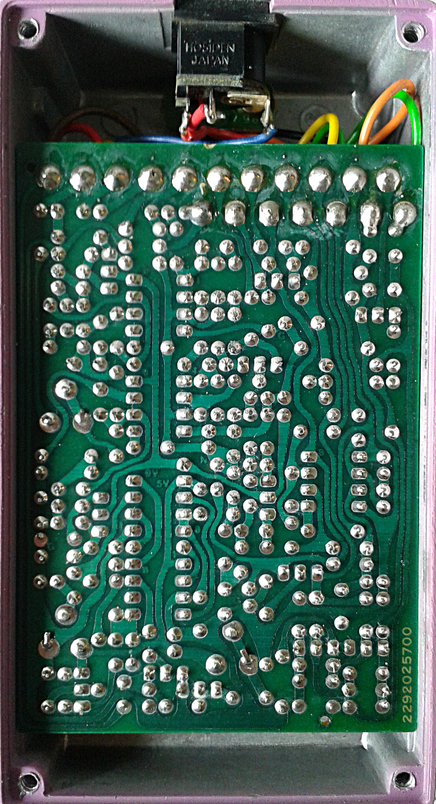
Boss-HF2-guts1

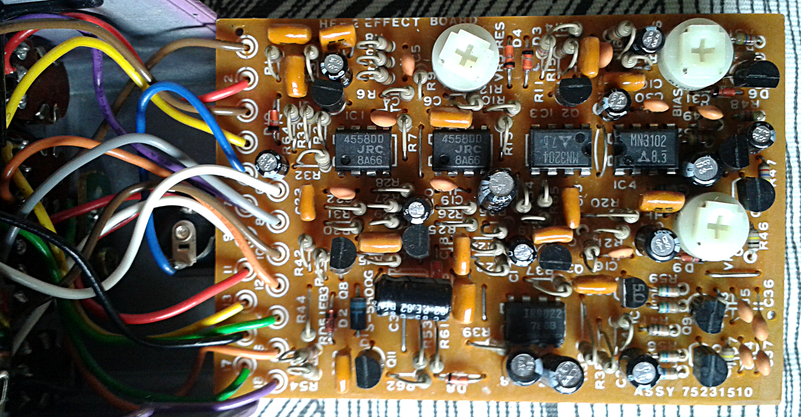
The board is full and still looking rather pleasing. The old school board manufacturing methods always please the eye. The delay section of the flanger isn’t anything special. It ihas MN3102 for the clock and MN3204 512-stage Bucket Brigade Device for the delay. The schematic is available for download through the interwebs. Looking at schematic, i’m not exactly sure how that half of IC2 and Q2 are supposed to create the clean octave up, but it surely won’t act only as a buffer in front of the delay circuitry.

Boss-HF2-guts2

That being said, the HF-2 isn’t your standard flanger, but it isn’t anything too special either. Controls are very sufficient. Manual affects the Rate and Depth, while Resonanse controls how much delayed, or flanged signal is getting in the mix with original signal. The footprint is pretty common with most flangers and choruses.

How does it sound?
Don’t be expecting anything too wild. It is a very nice sounding flanger that goes from mild detuned vibrato to airplane hights. Overall tone is still rather tasteless and scentless, the same problem we’re facing with many Boss boxes. Sure it sounds good, but it doesn’t quite reach that acidy velcro flanger wildness the greatest flangers reach. It does offer slight variance to most usual flangers, which is a good thing. Controls offer good variance in terms of speed and depth. For me, the best use for this is to have it act as a vibrato. I do get whyt some folks prefer this over any other, but that isn’t me. Good but somewhat boring.

Boss CE-3 Chorus

Boss-CE3

What is it?
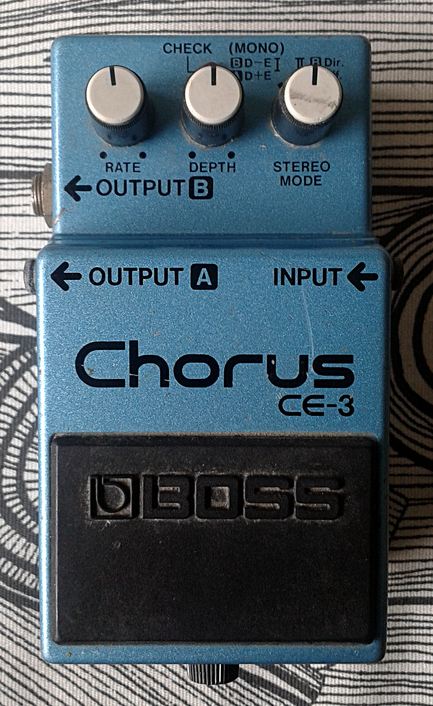
Boss CE-3 Chorus, made in taiwan, august 1988.

Boss choruses are all praised, even though the CE-3 has less reputation if compared the obvious classics like CE-1 and CE-2. With less reputation comes a less numbers on the price tag on auction listings. This particular unit is one of the very first CE-3s to come out of taiwan plant. CE-3 is the first Boss chorus with stereo output and there are couple of interesting things on the pedal. Like the position of the three knobs. Bossarea has more information listed.

Boss-CE3-guts1

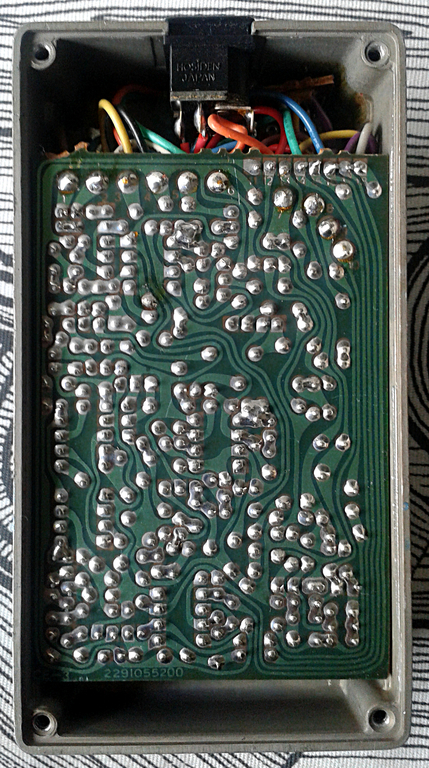
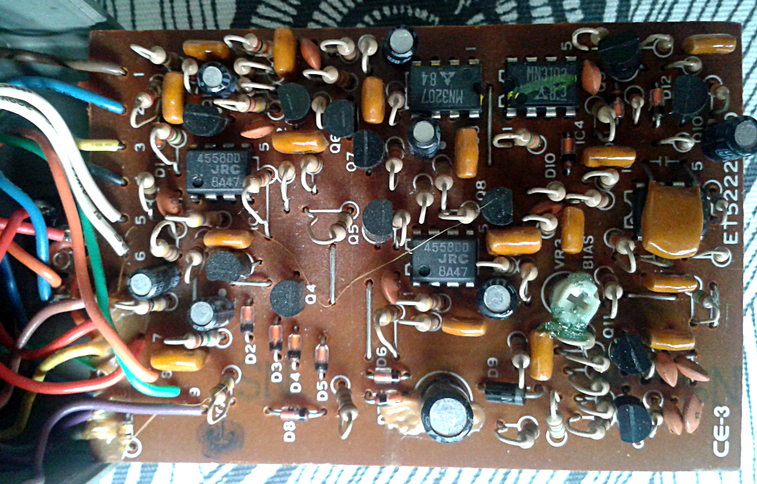
Board design is pretty with old school traces, but disturbing asymmetry on the layout. There is a schematic up on Synthdiy. Design is pretty common with two 4558s to drive the signal after the FET buffer and after the BBD modulation stage. The modulation stage is based on MN3207, a 1024 stage analog bucket brigade device. That chip is controlled by a MN3102 clock. Rate and depth are controlled by LFO, constructed with one TL022.

Boss-CE3-guts2

Stereo operation can be used to push zero and reverse phases to their own outputs, like many modern stereo choruses.

In general, everything about this unit is great. Vintage feel to the design, construction and it even offers some eye candy being as ugly as it is. And the most important part is yet to come..

How does it sound?
Soft and natural chorus. May not be as mellow and 70’s sounding than CE-1 and CE-2, but there isn’t that cold harsh detune around that, at least in my opinion, kills the usability of countless chorus designs. Depth control is sufficient, but i was surprised how slow the Rate is, even when maxed. This is a feature that makes the unit have a soul of its own.

Definitely one of the best sounding vibe-like chorus pedals in the price range.

Boss PS-5 Super Shifter

Let’s do a month with Boss pedals only. Why? Because i can. Starting the Boss august with PS-5 Super Shifter…

Boss-PS5

What is it?
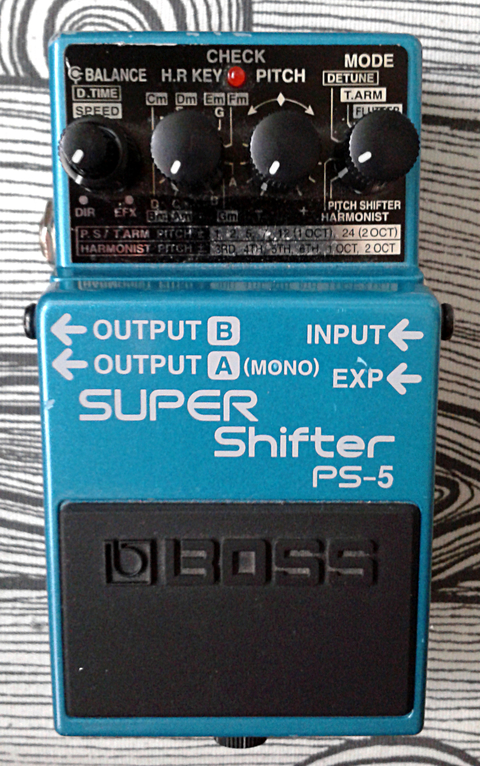
Boss PS-5 Super Shifter from Compact series. Made in taiwan in april 2008.

To begin with. As usual, i ran the serial number through the Bossarea.com serial number decoder. This is something i always do whenever i get a new Boss pedal for my collection. Of course i keep a list of all the Boss pedals in separate text file. Now this wouldn’t be anything interesting, but as the current collection is, i placed the PS-5 next to PH-3 on my list. I must have been slightly tired, but i couldn’t make a clear difference between the rows for PS-5 and PH-3 (ok, i always read/edit the list with an editor that uses fixed font). The reason i got confused for a second was that these both units are made in Taiwan and in april and in 2008. Plus when you think about the list with nicely tab formatted text, you’ll know the rows will have a lot in common. Super vs. Phase, PS-5 vs. PH-3 and the dates.  Anyway. Got this in a trade about couple of weeks later of when i first realized that i don’t have any dedicated “Harmonizer”, or “Pitch Shift” effects in my collection. Wasn’t actively looking to get one, but it just happened. The guy trading it told me that he thought it was a nice effect, but he didn’t seem to use it much.

Boss-PS5-guts1

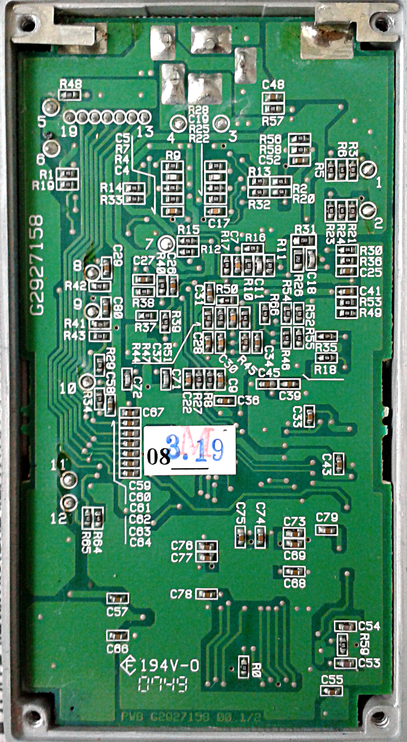
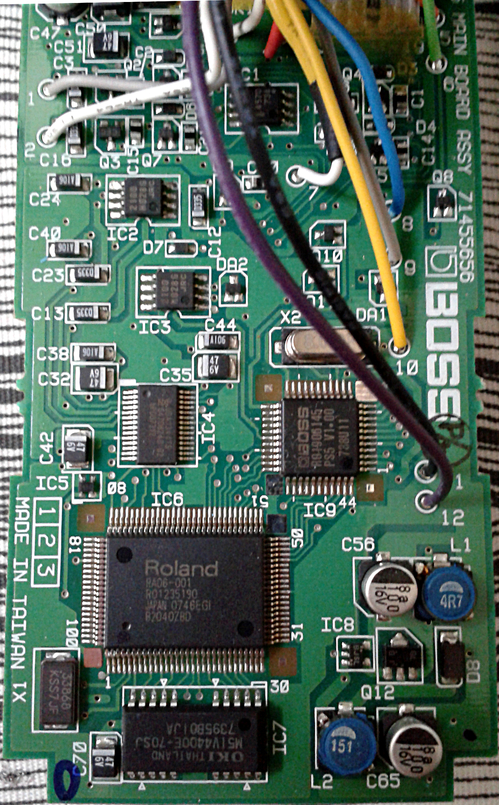
Opening the bottom plate showed nothing of any surprise. A board filled with tiny SMD components and so many “via”s that i lost count after the first 15 seconds. (For those not familiar with what i’m talking about – the vias are tiny holes on the board that are meant to take the connection to the other side of the PCB.) Flipping the board over continues with the same. A few big digital chips and a few operational amplifiers. Not my closest target for affection, but clean and neat nevertheless.

Boss-PS5-guts2

Which means that i’m not able to discuss the design at the moment. Yup. I simply don’t understand it well enough. There isn’t a schematic available, but the user manual is rather interesting read.

The unit is very feature packed. At first i thought the features just look like a lot and the up shifting is the main deal. No. That’s not it. I’ve been only playing around with this unit for a few hours since i got it, but mixed lightly on the balance pot and finding the tuning and a scale. That’s how it starts. It’s basically Boss’ answer to Digitech’s Whammy if you take a expression pedal and attach it to the PS-5. That plus all the static settings.  There are two features worth mentioning, even after all that. The “T. Arm” mode. The stomp acts as a momentary switch when this mode is on. This way one can get a digital reproduction of a tremolo arm function that comes naturally with Stratocasters. The last mode is “Flutter”, which is another digital reproduction of the thing most of us do with a tremolo arm. The features are pretty complex, so i’ll just leave you with that. And the link above to the manual.

Sadly, these features leave a slightly bitter taste. The question that rises, is this supposed to be a real, usable professional tool or just a toy to play around with? Other than that, it feels rather solid.

How does it sound?
The reason that guy didn’t use this much? I too was a bit put off by the number of features at first. There is a harsh digital feel to the most sounds this spews out. But i found the pitch shifter feature to be gold. Once the right extra pitch for the scale and the reasonable balance is set, this circuit sounds very good and nearly natural – despite all the digital harshness. Placing a fuzz after this will take a lot of the digital signature away and well, it’ll sound next to awesome.

In all, there are way too many different types of sounds to say exactly how this sounds. Some of the features sound very good and they have a purpose. Others are just picture clear resemblance of some plastic Tomy My First Effect Pedal toy. Toy aspect doesn’t feel too good, but there are a lot of usable range on the controls. If the user knows the pedal well enough, it may be a nice tool on a studio desk. Maybe the designing engineers tried just a bit too hard on this one.

Ibanez BP5 Bass Compressor

BP5

What is it?
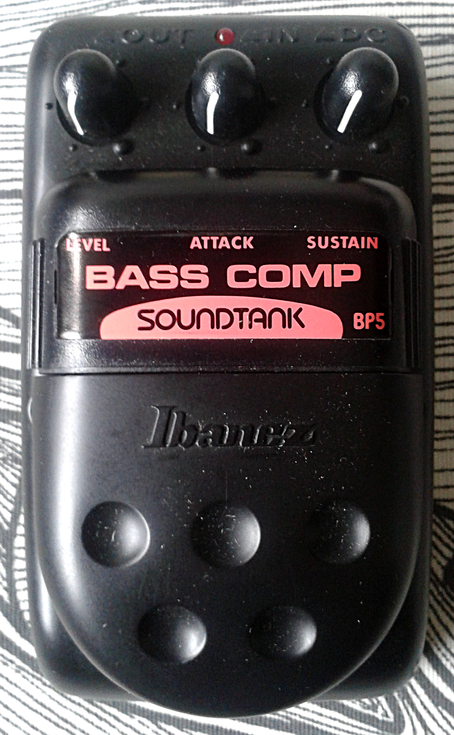
Ibanez BP5 Bass Comp compressor from the Soundtank series. Made in taiwan around mid 90’s.

Who would have thought that BP5 was the hardest unit to find in all the plastic Soundtanks? Well it was. The complete series did come by more easily than i expected, but there were still a couple of the units that were a lot harder to find than others. My guess is that the number of manufactured units were correlating hard with the sales. Which also means that there are tons and tons of Thrashmetals, Power Leads, 60’s Fuzzes and Tubescreamers just waiting for you to grab them. While the less succesful units are getting scarce, one should still be able to source the Bass Comp or Autowah for relatively low prices. If one keeps him/her eyes open. I did finally get one. Don’t exactly remember what i paid for this, but it wasn’t too cheap.

BP5-guts1

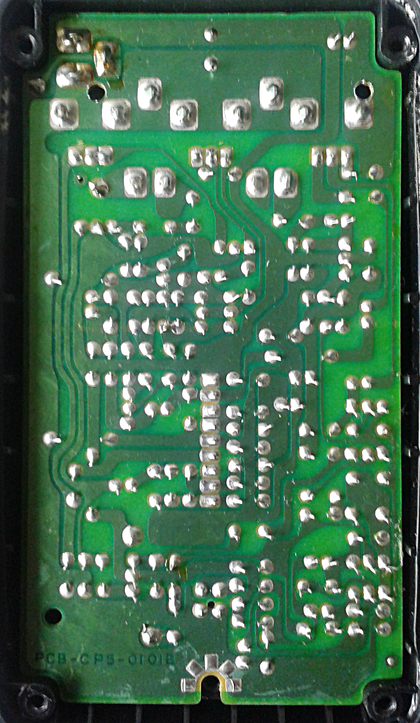
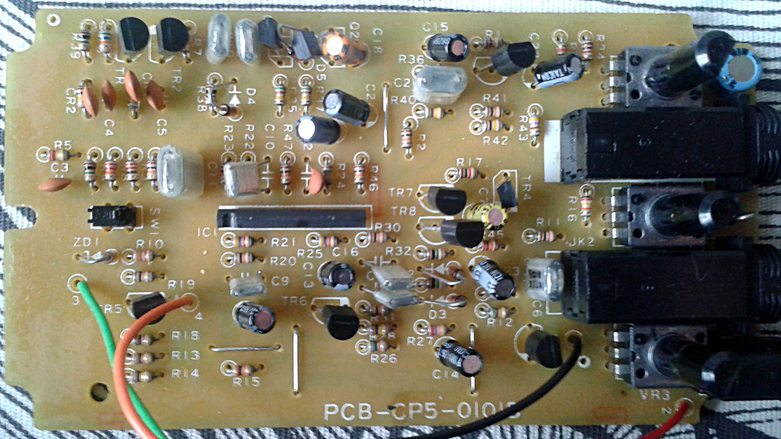
Once the bottom plate is out, the board looks exactly like the CP5, the guitar compressor from the same series. Once we take the board out to see it better, it is exactly the same board. Including the silk screened CP5 label. And if we look at these two closer, we see that there isn’t too much of a difference on the pedals. To be exact, the only change between CP5 and BP5 is one capacitor value. Sure. I knew about the differences before acquiring the unit, which may have been the reason i didn’t go for the ones that were out there with ridiculous price tags.

BP5-guts2

So this is pretty much the same pedal as the CP5, CP10 and CPL. Well designed and well working BA6110 VCA-based compressor.

I must wave a flag here. This is the last post about the plastic soundtanks for this blog. Yup. I’ve finally covered all of them. At the time of writing, there are still two metal cased units i’m on a hunt for. And those two are the original Thrashmetal (i’ve got three plastic ones) and the original Power Lead (i’ve got two plastic ones).

How does it sound?
If there is a difference between this unit and the CP5, i’m having real hard time hearing it. Not too noisy or mushy. I feel that the attack knob is rather useless, but that doesn’t make the rest of the features or sounds any less desirable. To sum it up, this is a poor man’s CP10. Defined and very usable unit. Superb thing with single coils. Haven’t played a lot with this on bass though.

EHX Nano LPB-1 Linear Power Booster

EHX-LPB1-Nano

What is it?
Electro-Harmonix LPB-1 Linear Power Booster from EHX Nano series. Made in US in 00’s.

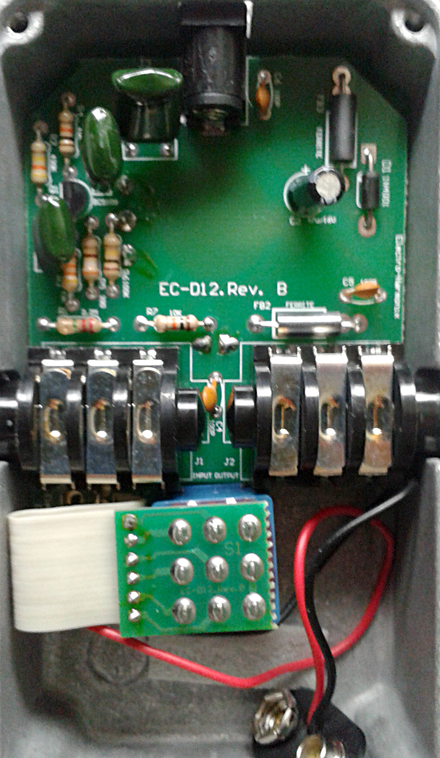
I’ve been over this units grandfather before in the form of EGO Microphone Booster. In its heart it is still the same simple one-transistor-as-amplifier booster. The base topology remains, even there are a number of modern additions to the box. First off, the bypass method is per modern standard, meaning a 3PDT stomp switch with true bypass. There are power filtering and polarity protection present and chokes for input and output. The tiny, simple circuit can now be powered by modern standard power supply or a battery. Board layout is really ugly and there’s acres of wasteland in there.

EHX-LPB1-Nano-guts1

I had a conversation with one person who was looking for plain volume boost for his setup and asked me what he should do about it. Get a custom build from me or try some commercial solution? Or some other option? I said “i think the best way to see if a simple booster is what you want, is to buy a LPB-1 as used unit”. You know, since you can get one for 25€ post-paid. I also said that if it didn’t suit him, i’d buy it off from him with that price. And here we are. I wasn’t planning on buying one, but i guess it’s good to have one of these too. and now the dude knows that he can’t get pure, clean power amp volume boost out of any pedal. He’ll need an amp that can do that.

How does it sound?
Like a single transistor booster. Clever and nice way to get your vintage-style single coils to light up. Some might even use this as a boos for clean lead sounds. But still i’d recommend this only for single coil pickups with lowish output. Ive been playing around with these circuits over the years, but once i got this unit.. I though it was broken. On any setting over unity level, it started to break up the sound in not so great manner. I checked the unit over and it was (still is) fine. I took another guitar and, yup. The super high output Hagström customs were just too much for it. The distortion created by too high input level isn’t pleasing.

Overall tone? Clean, colorless, tasteless, odorless simple boost. A tool.

DOD FX100 Even Harmonic Overdrive

DOD-FX100-EHOD

What is it?
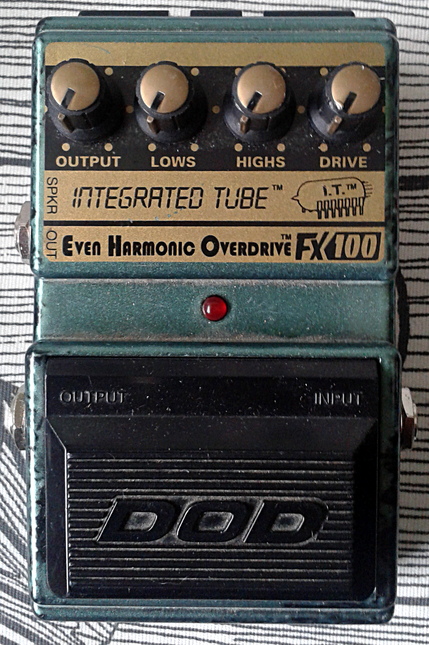
DOD FX100 Even Harmonic Overdrive (with Integrated Tube (TM) Technology. Made in USA in 1997.

Of course i was curious about this new and exciting thing called Integrated Tube (TM), or I.T. (TM) technology. What it actually is – it is how marketing department takes random words, put them one after another and place (TM) after it. Sure. It sounds very good and interesting to many to see new technologies arise and be put in use. And in this case, what does the I.T. (TM) really mean? There is a JRC4558 dual opamp in there. So my next question is, “Are you kidding me?!?”

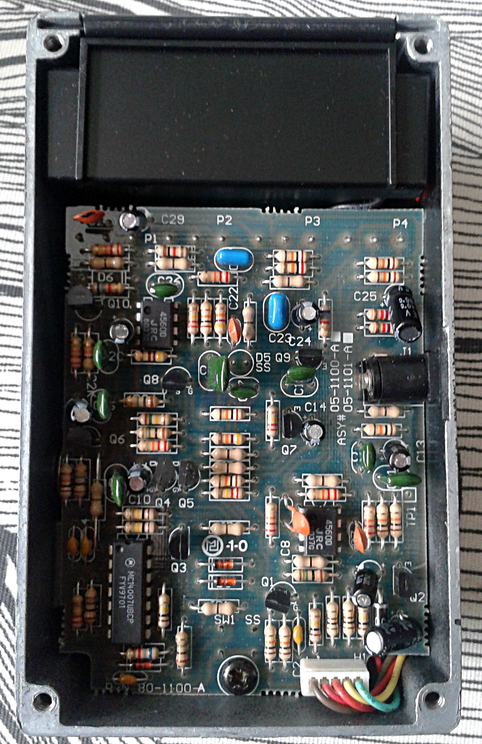
DOD-FX100-EHOD-guts

Actually, the two dual opamps it this late ’97 or early ’98 unit are JRC4560Ds. So apparently the I.T. (TM) doesn’t mean even that. Now let’s put the disappointment aside and check the schematic. Your guitar’s signal journeys trough a FET buffer and reaches a gain stage with Drive control on it. Then we have another FET/BJT gain stage followed by a strange world of single diode clipping (note to self – do not pay big money for FX101, as that is the same circuit, without I.T. (TM) and with a single diode added). Journey continues through a dual gyrator circuitry, which also is a home to Lows control. On the path comes a passive highs filter with a pot on it. This is also the place where we’ll have the volume control. After this, the journey is about to end. We have only make-up gain stage and amp simulated output stages left.

So did this journey warrant any claims for new and exciting technologies? No. Was it really worth it to get (TM) status to something that’s already been done over and over by just about every manufacturer?

Further reading on America’s Pedal website

How does it sound?
Ok sounding overdrive with sluggish output level. I’d say the level is insufficient for anything else but very low, vintage output single coil pickups. Clipping doesn’t feel broken, but nice, warm and harmonic. Even. Lows and highs are controlled nicely, but this just isn’t a very good pedal. Oh. Yes. It’s just my opinion. It doesn’t mean that the unit would really suck. It just means that after the marketing department had its way with me, then come the real issues. Makes me wonder i should just solder that missing diode in and pretend this is a FX101.

Danelectro DJ-20 Rocky Road Spinning Speaker

DJ20-RockyRoad

What is it?
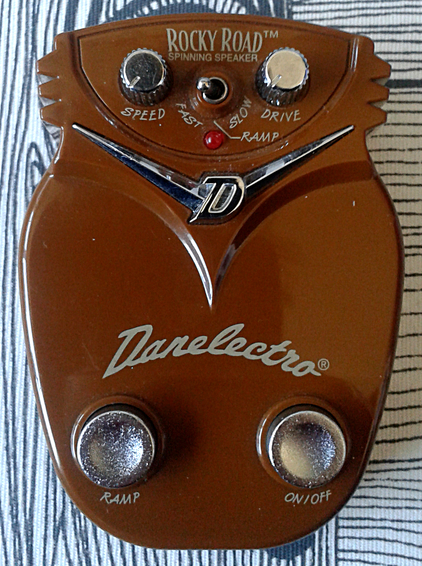
Danelectro DJ-20 Rocky Road Spinning Speaker from Danelectro Mini series. Made in china around mid 00’s.

Leslie simulators are one sub-genre of effects that i haven’t had a lot of interest on. Is it a tremolo? A vibe? A Chorus? No. It’s a Leslie simulator. Which translates to it being a tremolo, vibe and delayless chorus. In essence, it is a amplitude modulation effect, designed to give you a feel of a spinning speaker-like illusion. Sort of like a stereo tremolo/vibe that goes ping-pong. In fact, a Leslie simulator is nothing more than a marketing scheme. Rarer the idea for the pedal, the better chance to sell them.

DJ20-RockyRoad-guts

On the technical side, the effect is created with a HE83015 8-bit micro-controller. There is a schematic for the complete circuit on the builder forums (you’ll need to log in to FSB to see it, so no link at the moment). Basically we have a overdrive/distortion that’s given to the programmed digital controller for amplitude modulation in stereo (or that’s how i read it). And once again, my shortcomings in the area of digital micro-controllers prevent me from digging any deeper. For now. So it is a lot more complicated than what you would expect from a stereo tremolo.

Design has peculiarities like only Dano can deliver. The Ramp up/down feature  only works in fast setting. And the distortion, or the Drive as it’s called…

How does it sound?
Um. I don’t know what to say. The drive part sounds pretty awful with its broken sounding clipping. As a huge disadvantage, we also have a volume boost when effect is activated. Only good feature is the ramp. This offers fun and wild modulation speed changes that are gradual, not instant.

This unit has gained some status, but why.. Beats me. Nice novelty toy, but not by far a good, usable effect. If a real Leslie sounded like this, i have a hard time believing anyone would have ever used one for anything. To sum it up – this definitely has something inside that we don”t see every day in pedals. But that doesn’t make it any more good than what it actually is. A novelty toy.

« Older posts Newer posts »

© 2025 killall -9 humans

Theme by Anders NorenUp ↑