Tag: Distortion (Page 7 of 7)

DOD FX33 BuzzBox

DOD-FX33-BuzzBox

What is it?
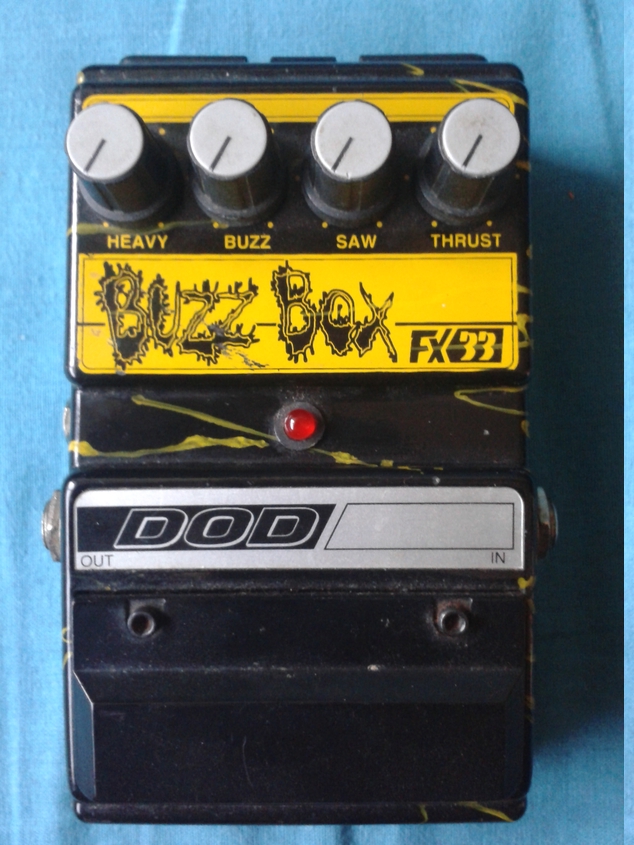
DOD FX33 BuzzBox, made in USA around 1995.

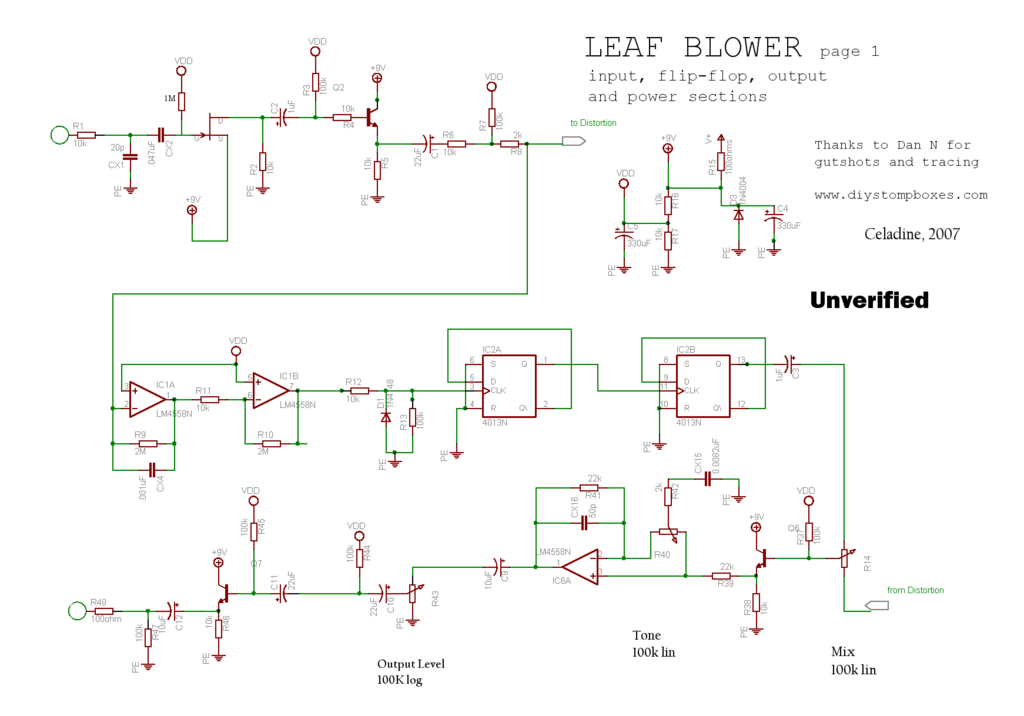
Now here’s something you won’t see everyday. When something is worth overdoing, let the DOD engineers show you the real way of the beast. Design is just sick. The America’s Pedal article on the history of the design is a very good read. There is a schematic available online, named Leafblower. It’s drawn by Celadine and it is spread accross two pages. It’s not that complicated, but still a big design.
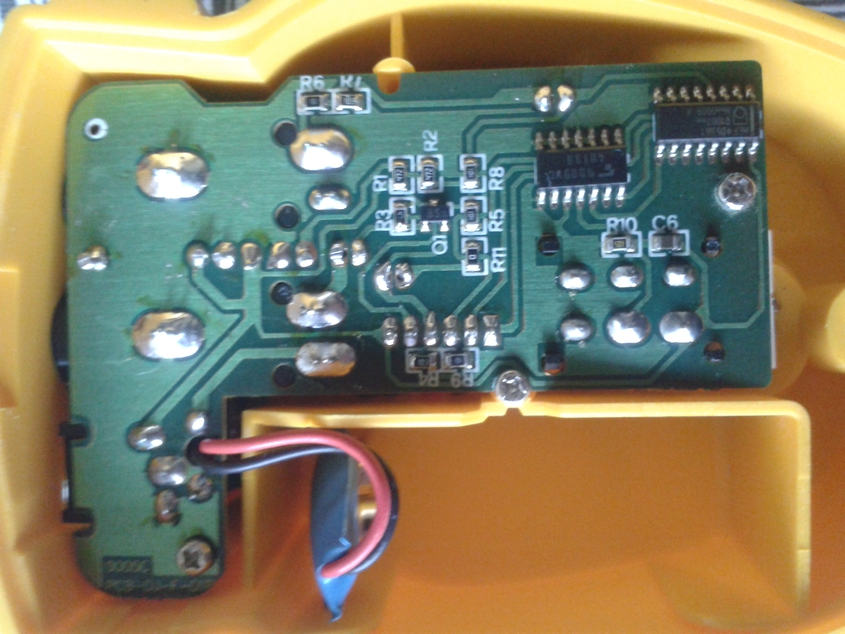
DOD-FX33-BuzzBox-guts1

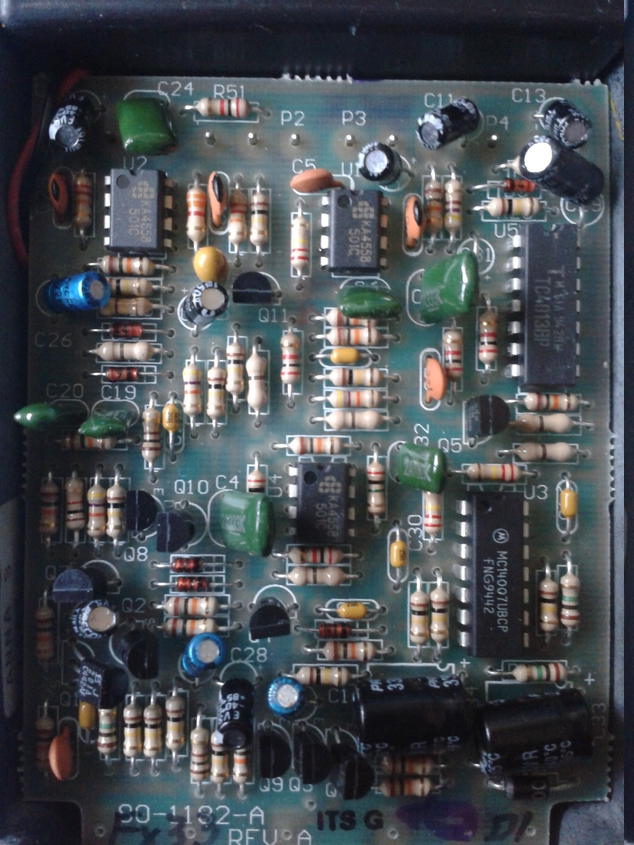
So in fact the design has distortion and octave divider in parallel, which is nothing too special when compared to other low octave divider circuits around. But this time the voicing and gain are set quite perfectly for extreme buzz. The controls work well, even though the names are gibberish. Heavy is controlling the mix between distortion and low octave output, Buzz acts as distortion control, Saw as tone and Thrust is your overall output level.

DOD-FX33-BuzzBox-guts2

As a nice curiosity, there’s a sticker inside with ” Dana B 232″ printed on it. These units usually sell for a lot. I happened to be quite lucky and got one from a friend in a trade that was good for both of us. Thanks Markus.

Due to the circuit being more complicated than its peers, it’s not your average suspect for cloning. After all, there are three dual opamps and a CD4013 flip-flop in addition to a few transistors and clippers. But from economical point of view a reissue should be welcome.

How does it sound?
Massive low octave noise monster. Some folks claim it to sound like a Rat driving a Bluebox, but to my ears it’s not even close. Think of two DOD Grunges in parallel and blasting the resulting hyper distorted signal through quadruple bass booster that has all the frequencies divided into lower octaves ála Bluebox. Yes. It is that sick. in the same time this sounds like a mash of a leafblower, a vacuum cleaner and a demon possessed NES system on speed.
Danelectro DJ10 Grilled Cheese Distortion

DJ10-GrilledCheese

What is it?
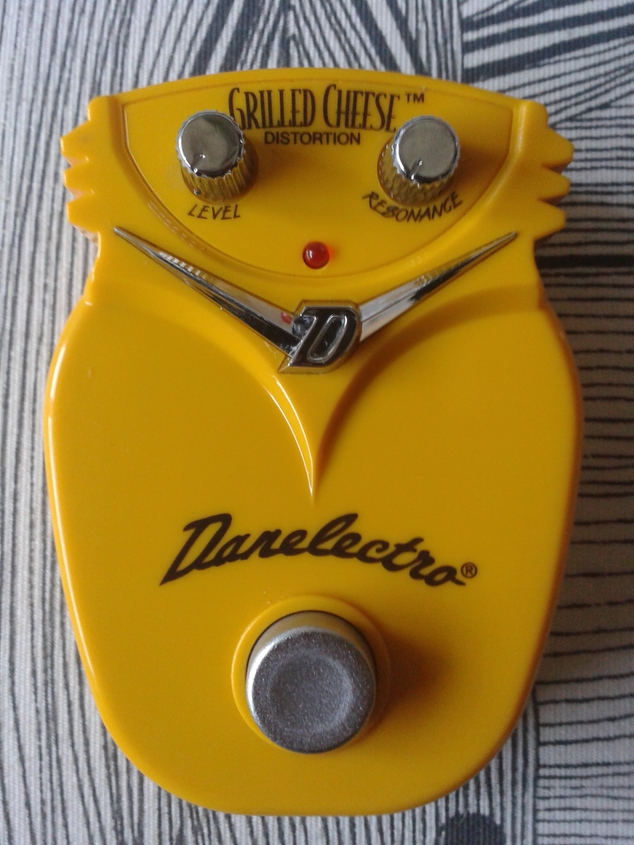
Danelectro DJ-10 Grilled Cheese distorion.

Had no information on the design whatsoever when i got this unit. Should probably have done some reading before paying 20€ for it. As distortions go, there is one sub-genre that i find no joy in playing with. This one sinks to that genre. Fixed wah distorion. As the ones i’ve played with, the Ibanez CD5 Cyberdrive is the least sucky in the bunch. And that too sucks quite a bit. That may be suitable for some special lead sounds usually employed by men in tights. So i may be a bit biased when judging this pedal.

Couldn’t find a schematic and to be honest, this unit does not interest me enough to even dig deeper. The comments on the internet say that there are 3 dual opamps and a inductor that make up the circuit. Bypass seems to be standard of the mini series.

DJ10-GrilledCheese-guts

One of the rare cases of complete meh. Which means i have no interest in seeing how or why this one does what it does.

How does it sound?
Like all fixed wah designs with mid scooped distortion, not completely unlike DS-1 or alike. Personally i wonder who would need or want a sound like this. It’s not my place to judge, so if you find fixed wah distortions useful, go ahead. This one will remain in mint condition in my collection.

Danelectro D3 Fab Metal

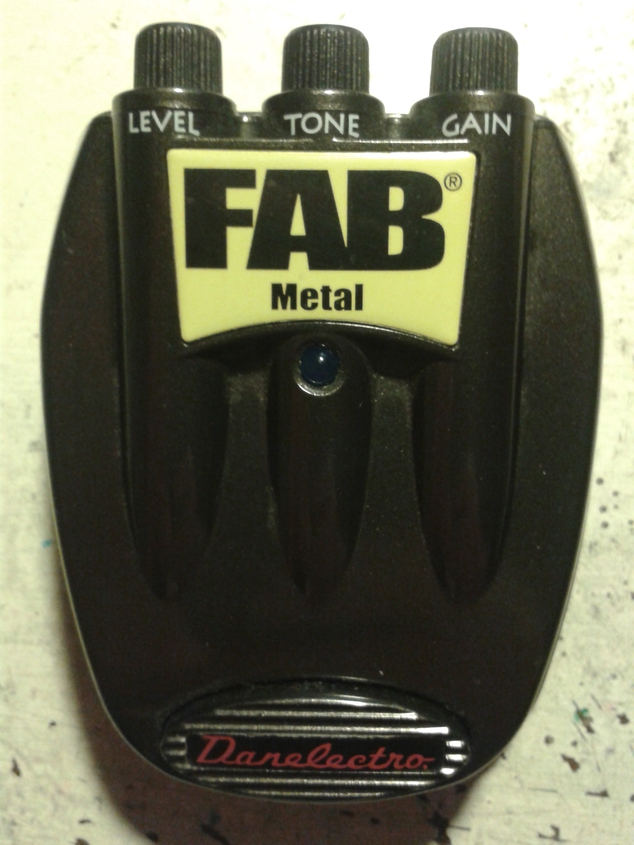
D3-FabMetal

What is it?
Danelectro D-3 Fab Metal. Fab series, made of plastic and probably the cheapest thing you’ll ever see.

For some reason i seem to gather metal distortions even i’m not a big fan of metal music or the guitar sounds commonly affiliated with it. I do think it’s fun to play with metal distortions at home though. So while i’m gathering more of the missing Danelectro boxes that i want, these tend to arrive in the meantime. Where mini-series boxes vary in build quality, these are very consistent. Consistently bad. As new units currently sell for 15-20€, it is no wonder the build costs have been cut in every single step of the way. Not to say that these wouldn’t work. They will, probably until the end of time. But the board is shielded with a piece of paper that has a layer of tin foil on the other side. Magnet for radio frequencies and manifestation of bad business orientated thinking.

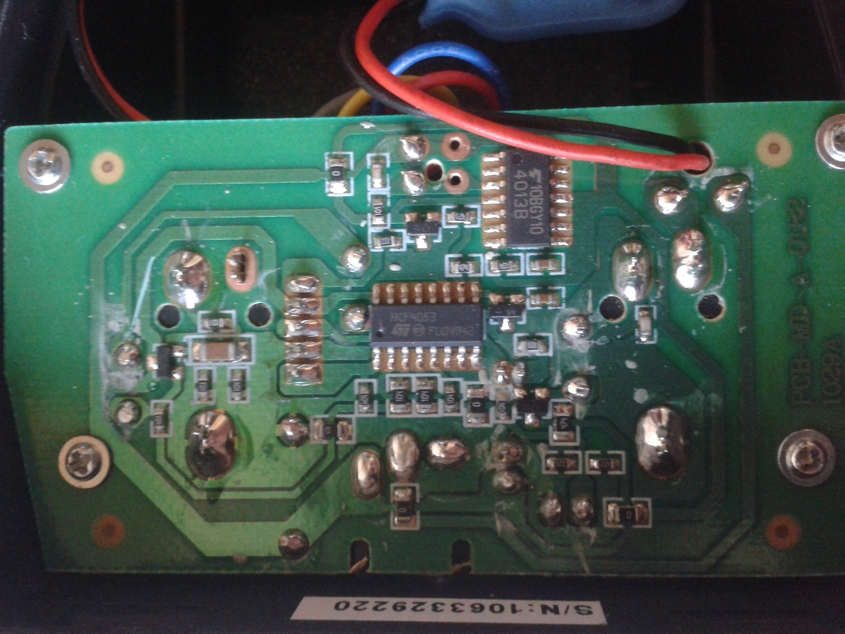
D3-FabMetal-guts1

There’s flux residue all ovet the board and soldering looks astonishingly bad. I always have hard time looking at component selection that’s mixing SMD and thru-hole components. Plus the board design looks like a winner of “who can whip up a quickest PCB design” contest. Auto-router is another possibility here. Not eye pleasing at all.

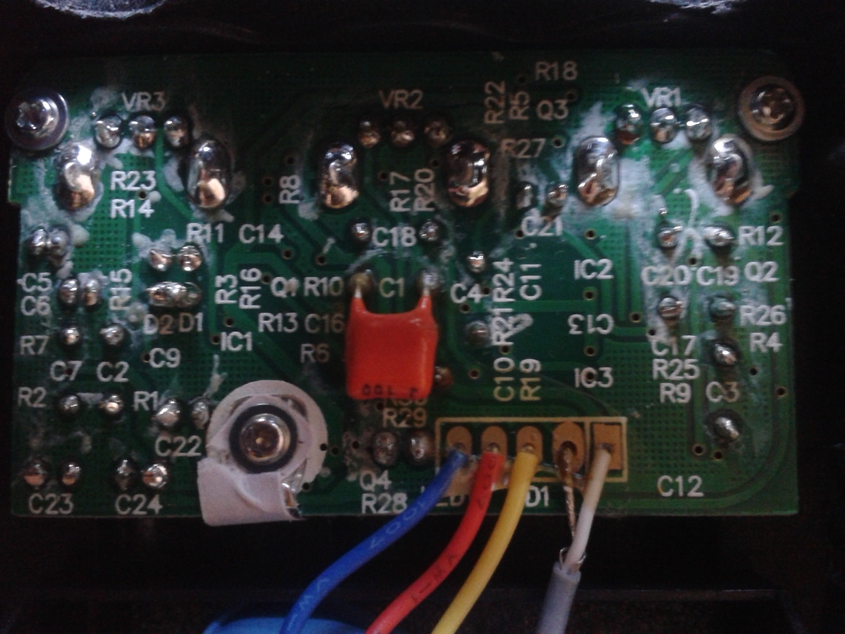
D3-FabMetal-guts2

I can say with certainty that Fab series isn’t designed for active guitarists, but those who are starting to learn guitar – a perfect way to kill the starting enthusiasm for tone hunting is with these pedals. It could be argued if Danelectro should have released these at all. In my opinion, they shoudn’t. These hurt the brand and spread misconception that all Danelectro boxes are made with same (lack of) integrity.

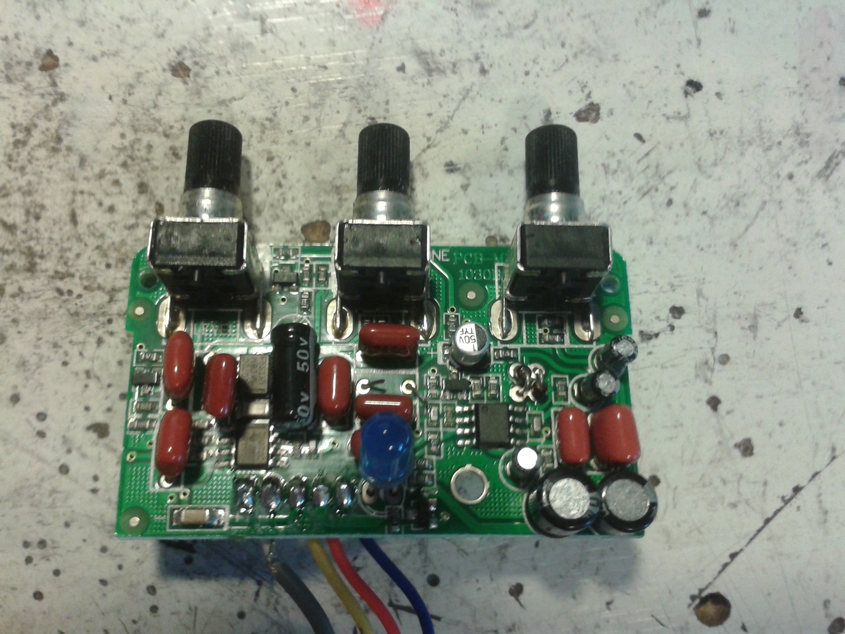
D3-FabMetal-guts3

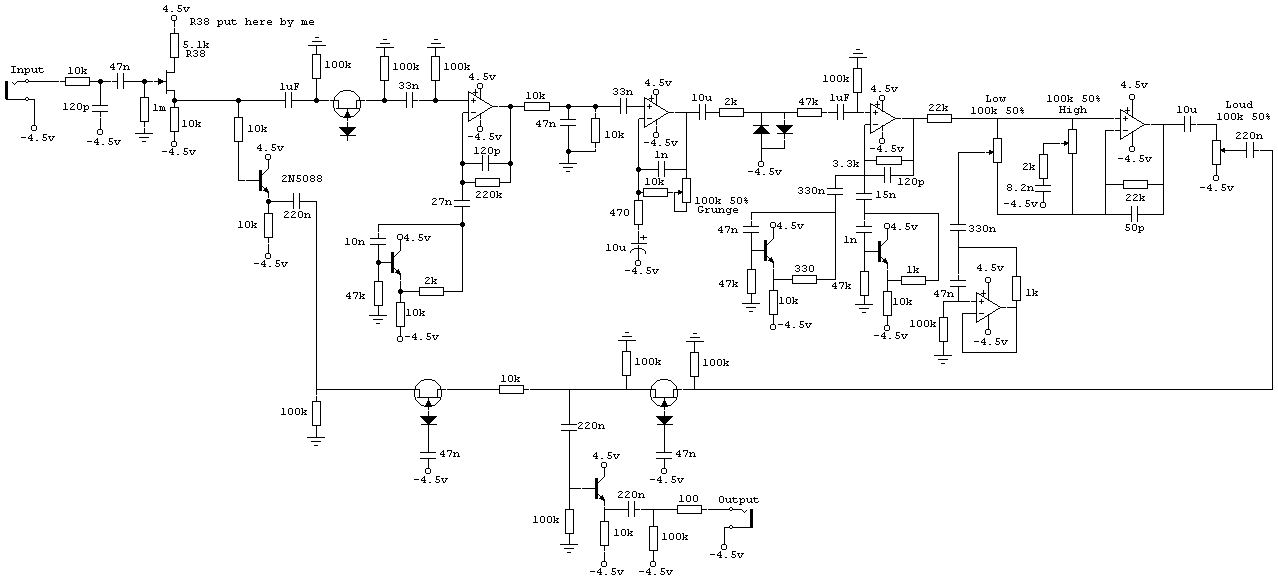
The design itself is your standard distortion with gyrators and multiple gain stages. Mr. Jones has drawn a schematin in 2006. This doesn’t have component values listed, but i suspect this may not be prime suspect for cloning or modding…

Like stated, the build quality alone make these very much undesirable boxes with no value at all. May the designs inside be how bad or good ever, you’ll be a lot better off with modern chinese cheap brands than these. These may be slightly cheaper, but still. Wouldn’t recommend this series to anyone. This may be the point where i draw the line. I have nothing against Mini series or plastic Soundtanks. These have been created to make money. If the retail prices are as low as 17-22€, you can imagine how much time, effort and quality gets in to the final product.

Danelectro. Please stop killing yourself.

How does it sound?
Awful. Didn’t have very high hopes for the unit, but as a metal distortion, it sucks. However. Once the gain is maxed, this turns into digital sounding fuzz rather than metal distortion. Which isn’t good, but it may have some use in certain situations. As a guitar effect? Avoid this like a plague. As a power electronics noise tool? Maybe.

And no. I won’t be finishing my Fab collection. Ever.

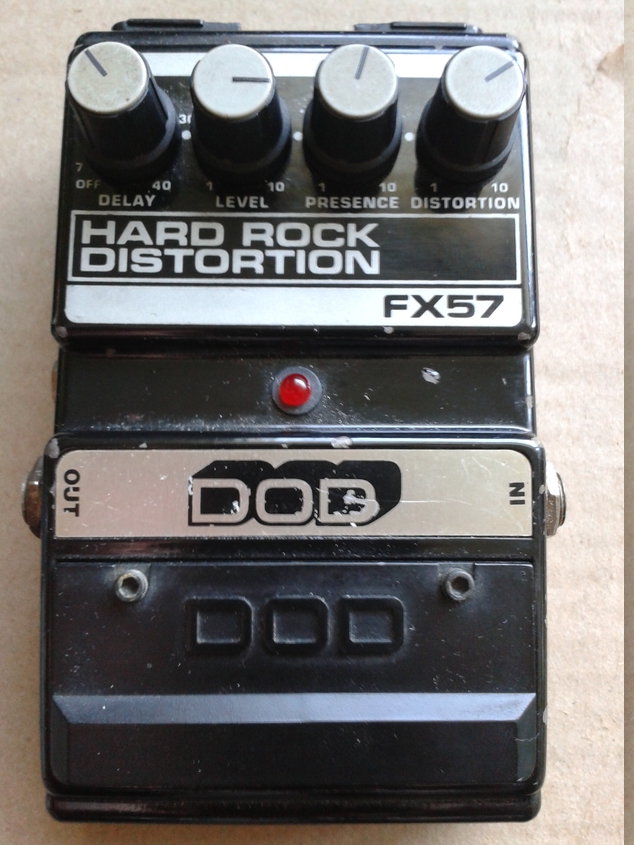
DOD FX57 Hard Rock Distortion

DOD-FX57-HardRockDist

What is it?
DOD FX57 Hard Rock Distortion. USA made box, dating 1987.

Bad year. 1987 i mean. According to DOD information heaven, America’s Pedal website, the basic idea for this design was already tried out on certain DigiTech double pedal, as well as on one Boss design. And what is this idea? To take a OD/Distortion and place a delay circuitry after it to “widen” or “thicken” the sound. I must say that the idea itself doesn’t sound that bad. Distortion with analog delay? How could that be bad? Well it can. For those interested, the schematic can be found online at Schematics Unlimited. It shows that the delay section is placed  after the main gain stage and to be mixed back to the distorted signal at the level control. The delay itself is created with MN3007/NM3101 pair. Level control is mixing the signal, delay included or not, with virtual ground and passing it to the presence control. The distortion control is basically just a variable resistor limiting the input signal current after the mandatory input buffer – which is needed due to basic DOD electronic switching. There are two trimmers that affect the delay functionality.

DOD-FX57-HardRockDist-Guts

The board looks kinda cool with those yellow mylar caps.

Now what exactly makes this a bad design? Two things. The distortion and the controls. That is a lot for one design. With the soft clipping, placing four Si diodes to the feedback loop of the gain stage offers something that isn’t too far from tube screamers, but the filters and second clipping stage (the Ge diodes) before the volume control gives out texture that isn’t too desirable. And that presence control would need a huge rework to even remind me of anything reasonable.  I personally think that presence is just a wrong word for this control. It should rather be “extreme bass cut pot that we here at DOD didn’t think all the way through”.

How does it sound?
Bad. Thin, hollow and nasal. Turning the delay off doesn’t quite help you. With the distortion at minimum and delay maxed, we can get something that reminds one of usable sound. But it is pretty crappy sounding design. Not all the settings are awful, but none of them are particularly good wither. Overall experience is so crappy, that i have high hopes for this becoming a rare gem – due to low(ish) number of units manufactured in relatively short period and the fact that some people will dispose their units with their everyday garbage. Which wouldn’t be too crazy idea with this particular unit. Not all of the setting combinations are horrible, but in genereal; it sucks and it sucks hard. But it is an interesting failure.

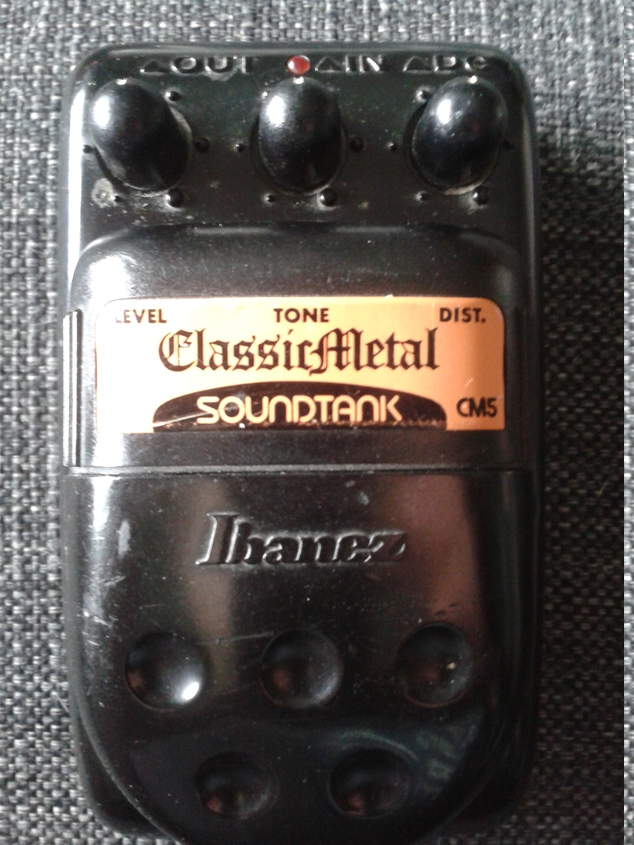
Ibanez CM5 Classic Metal

CM5

What is it?
Ibanez CM5 Classic Metal from Soundtank series in plastic enclosure, made in Taiwan. Condition could be better, but after swapping the switch it runs like a charm. I never thought that dents or scratches affected the sound in any way. Late 90’s date, so this unit isn’t the most valuable soundtank in my collection, but its value comes more easlily through use.

This is one of the pleasant surprises in the series. Name and basic controls do not raise interest that much, but once plugged in, my face just raises a smile. Clean high gain distortion without noticeable noise content. Simplified Rat as main gain stage that drives a pair of hard clipping diodes. Followed by two active gyrator filters for tone control and taking ecxess frequencies out of the signal. Standard Ibanez switching and buffering included. Simple, yet effective.

This one’s gain stage could be modded closer to a Rat, but as it is – i simply don’t see a reason to do so.

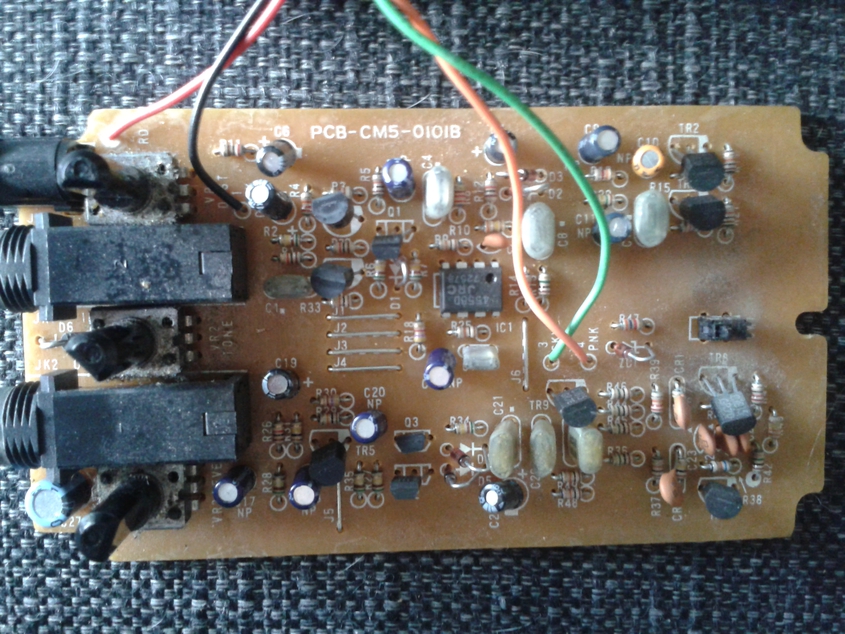
CM5-guts

The board seems quite spacious when compared to some other Soundtanks. Basic, good use for JRC4558. Other half for gain stage and other for tone driver. Again. Simple, yet effective. For those interested, Dirk has a schem up at his site. All in a nutshell – its main stage may be based on a Rat, but overall design doesn’t have too much in common.

How does it sound?
Surprisingly good. Subtle overtones for those high note bends, massive but accurate chord rhythms. In general, very underrated pedal with really good sound. It is just a one trick pony, but does that trick really well. One that should not be overlooked.

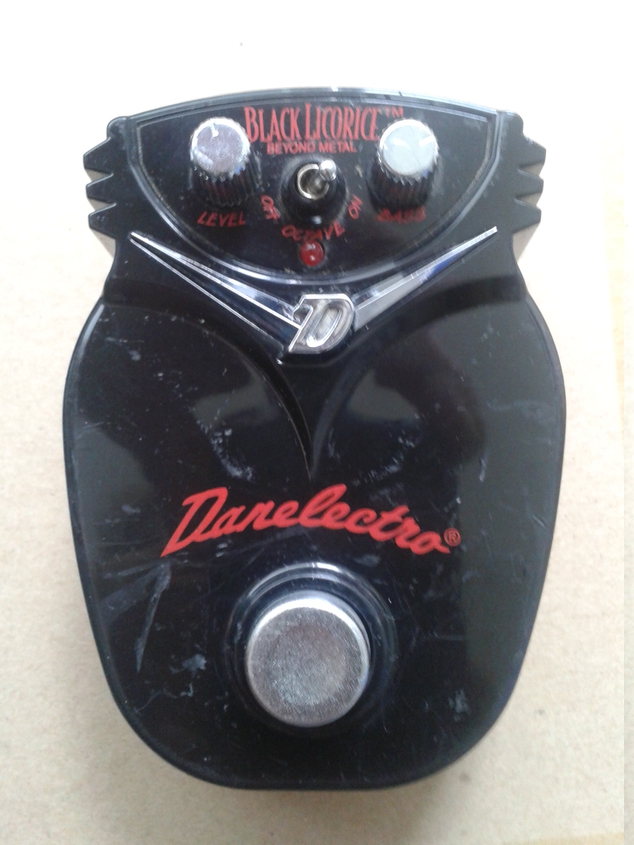
Danelectro DJ22 Black Licorice Beyond Metal

DJ22-BlackLicorice

What is it?
Danelectro DJ-22 Black Licorice, Beyond Metal from Danelectro Mini effect series.

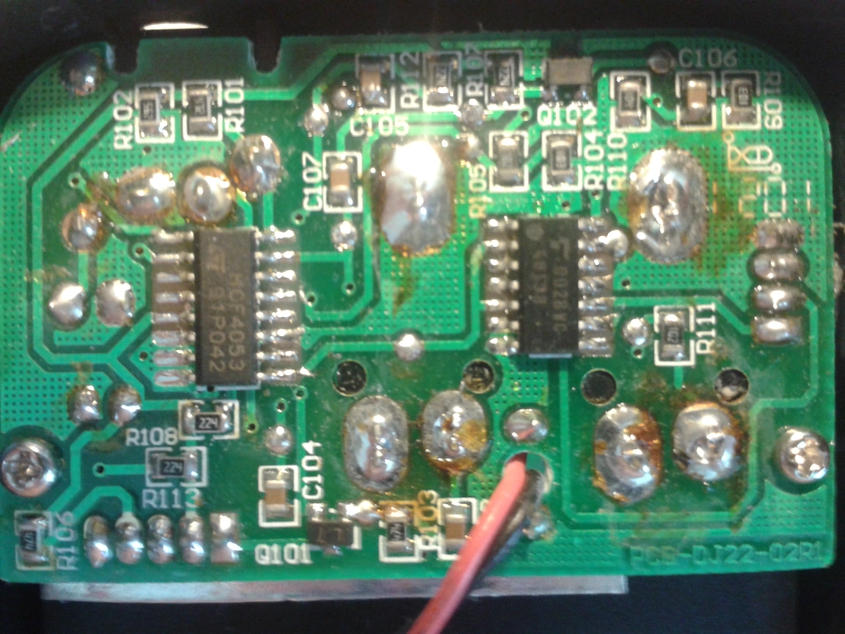
While many designs in the notorious mini effects series are surprisingly good and most of the designs have some really nice tweaks or upgrades to some other, known classic circuits, this one disappoints in so many ways. If you didn’t know already, i’m somewhat a freak when it comes to octave down effects. As some of you may know, the most common way to create down octave divider sounds is to drive the hell out of  CMOS flip-flop IC. This one is not an exception to that rule. Design reminds me of also notorious MXR Blue Box. There’s something very wrong with the distortion design and the way it handles lower and mid frequencies. Board also feels way too crowded to bother with modding it for more pleasant frequency response.

DJ22-BlackLicorice-guts

Standard mini plastic enclosure, crammed with substandard soldering. Toggle switch bypasses the octave dividing circuit, which acts pretty much in the same manner as Blue Box’s blend control. Next paragraph will tell you why i didn’t dig any deeper to what it does and how.

How does it sound?
Bad. Honking, plasticky and thin, despite the basic octave divider circuitry. Where Dunlop’s Blue Box sucks with its way too low output, this one sucks with everything else. Divided octaves sound reasonable good, but the distortion part is just bad. Worse thhan Fab Metal (more on that later…). Definitely one of the worst (re)designs in this series. Wouldn’t recommend it, unless you are a true down octave aficionado. And even then. This may be good only for trying it once. My first encounter in this series that sounds exactly like it looks. Too cheap. This may be the one Danelectro effect that won’t ever let you get your pennies back.

Digitech DDM Death Metal

Digitech-DeathMetal

What is it?
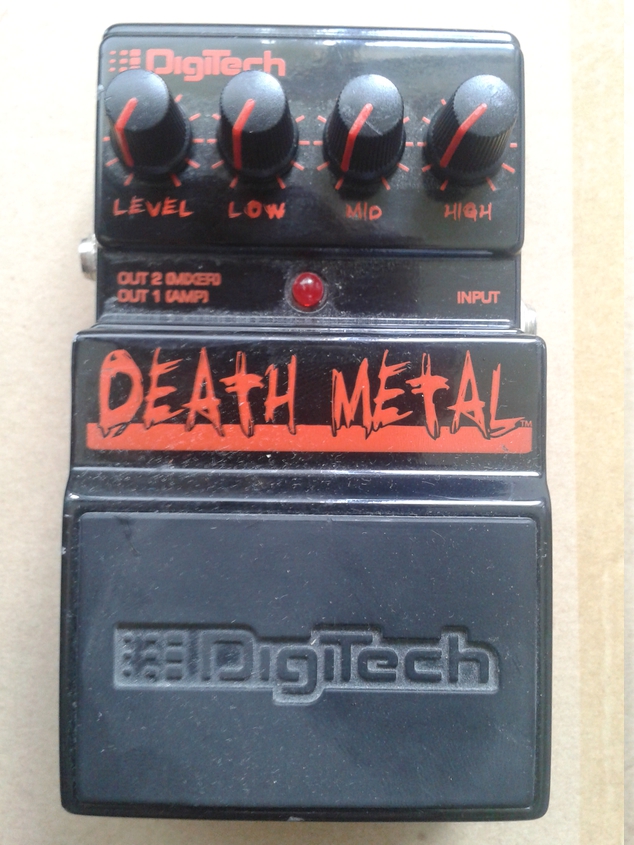
Digitech Death Metal distortion. Modern issue from Digitech Distortion series. Built around 2009.

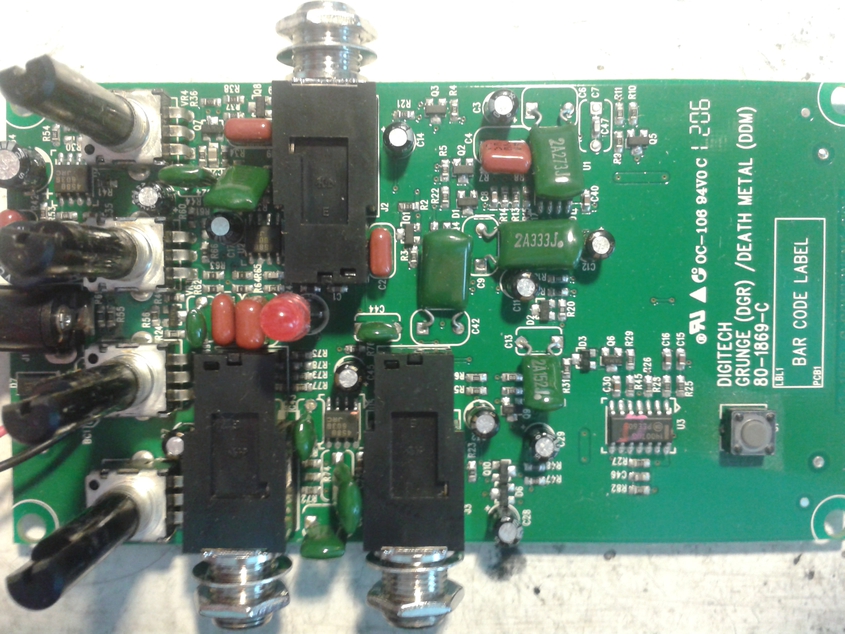
Why would i post this effect? To be honest, i acquired it just because i was curious. Didn’t check any demos or read any reviews before i got it. Didn’t even think about getting one, but as the opportunity where i could get one for next to nothing with some other pedal that i needed showed up – well then. Here we are.  Once i opened this up, i was convinced of the genius about the enclosure design. It doesn’t leave a of lot room between the board and top of the box, but the way metal top and bottom hold the PCB and jacks is very nice. For some reason i find it interesting that the components used are sort of an hybrid. SMD, through-hole mylars and panasonics. Not that there’s anything wrong with that – capacitance is still capacitance, no matter what material rocks your boat. But is it neat and/or convincing? Maybe not. or maybe even definitely not. The splitter feature at the output is good to have, while i don’t see any application for using it.

Digitech-DeathMetal-guts

Other thing that made me smile. DigiTech continues with the DOD heritage of using one board for multiple designs. Apparently this one shares a board with modern layout version of the Grunge distortion. These designs may have a lot in common, but it puzzles me how the gain/hi/lo/level setup of the Grunge can be transformed into hi/mid/lo/level. Looking at the Grunge schematic, Death Metal would need a new filter to where the gain control is. This can be achieved with omitting couple of components from the Grunge board – while adding them to make it Death Metal. Plus the active filters after the main gain stage will need all new component values to match the frequency response of each of the designs.

Does the main gain stage look familiar to you? I think i’ve seen it somewhere… Yeah. In about 350 different distortions since 1980. 100K pot for gain and a hard clipping after it. I’m calling it “The Mouse Design” (or YAM) from now on.

How does it sound?
Not bad. I’ve used it in a couple of rehearsals for leads. Not sure if i’ll ever attach it to my main board, but it is a good, cheap tool for rich super high gain sustaining leads. Output level is more than just satisfying, while the noise levels stay in tolerable amounts. This hound (not exactly a puppy) doesn’t have a gain control at all (not a con, when was the last time you turned the gain down on any metal/high gain box?) Just an usable three band EQ to dial it in max on bass, treble and leave the mids slightly scooped. There you go with beautiful hardcore lead sounds. To be honest, this may very well be a decent budget alternative for Metal Zone. Don’t know what more to expect, but this is very cheap and durable tool. Wouldn’t call it perfect or even desirable. But as a tool, it may very well stay with me for a long time. I almost sold it already. Glad i didn’t. A tool.

Ibanez LF7 Lo-Fi

LF7

What is it?
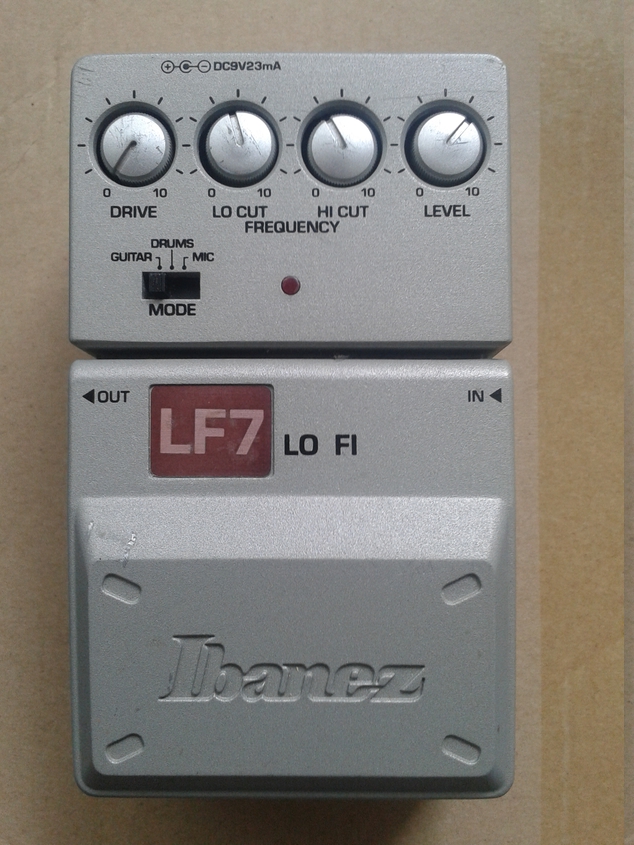
Ibanez LF7 Lo Fi from Tonelok/7-series. Apparently made in the year  2000, as the enclosure has the date 1/2000 stamped on the inside.

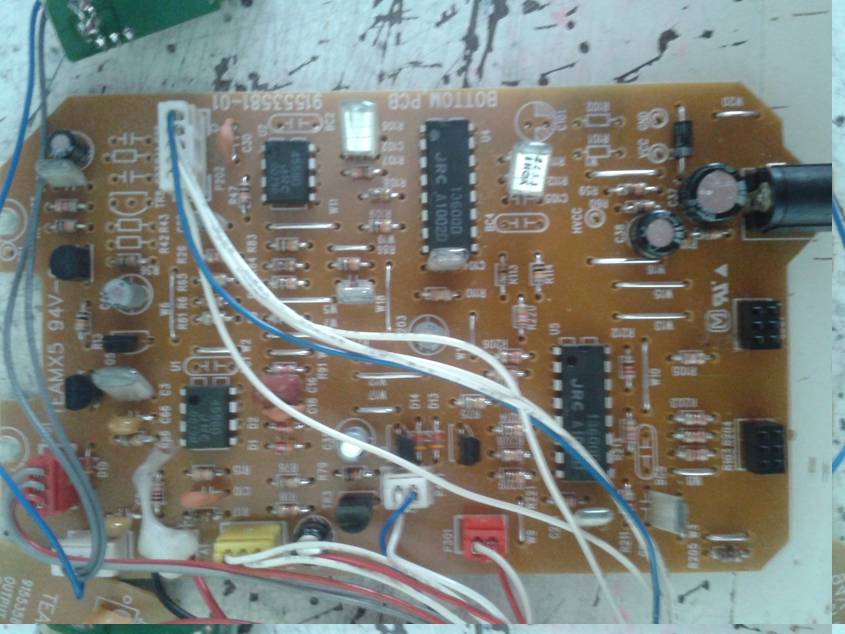
The board itself has a lot of components left out, so it seems that the same board may be utilized in other designs of the series too. I think i may need to do some reading on this. As the circuit is what it is – a distortion with active filters, i think i’ll focus on the enclosure and how the 7-series are made, rather than trying to analyze the circuit on this particular design.

LF7-guts1

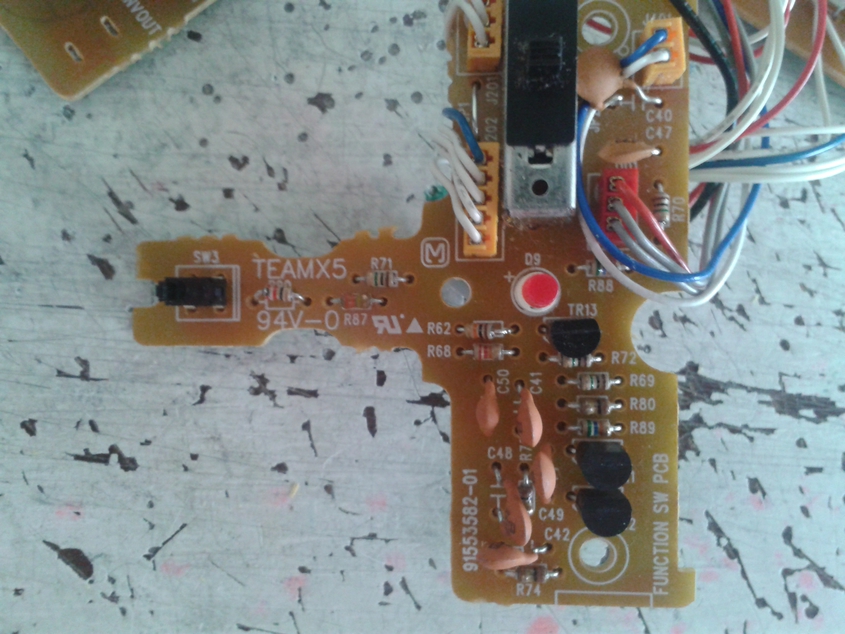
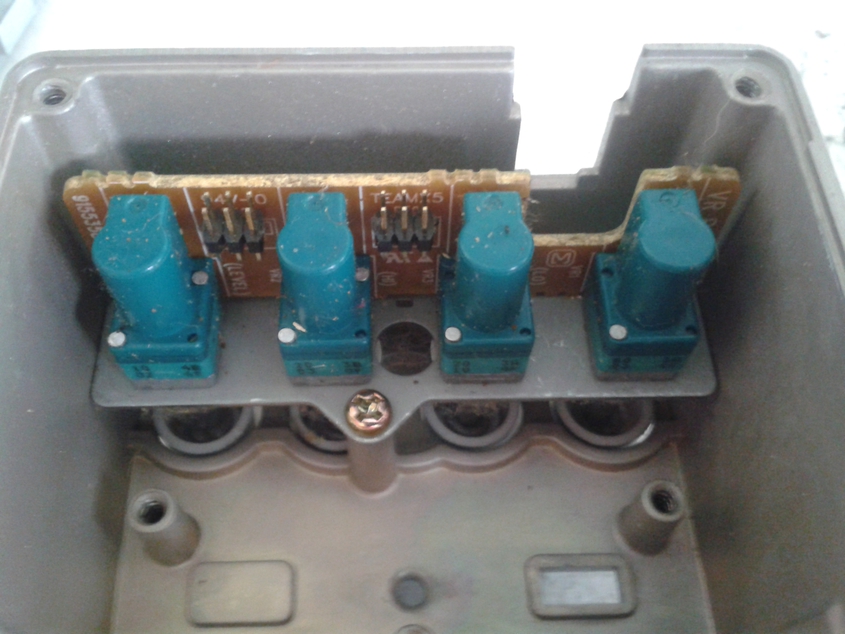
The base design for 7-series boxes is made of 5 (!) boards. One for input jack, one for the switching, LED and slide switches (picture below), the main board (above), the control board (aka VR Board) and one for the output jack. It is crowded in there, but this type of design leaves a lot of room for the main board. Which is huge when compared to compact size of the pedal itself. There is a downside to this. Over engineering. You need to use all the space available, right?

LF7-guts2

Meaning that the same results in sound could have been achieved for a lot smaller board and lower parts count. The factory schematics can be found online, but study them with caution. These are the worst schems i’ve seen with depicting of all the 5 PCBs, showing some parts of the layout and having massive, unnecessarily long lines. These also notes how all 5 boards connect together. Good information,  but difficult and/or frustrating to read.

Back to the good things. These also seem to built for war. Couple of the units i have were mailed to me wrapped in just two pages of newspaper and a thick paper bag. Knowing how the postal service treats the parcels, i was quite surprised how none of these had any issues after such treatment. The Tonelok-idea is not a bad idea at all. I’ve run into issues accidentally kicking the pot knobs on some pedals (think ZVex’s Fuzz Factory) that have the stomp switch way too close to the knobs. Add trigger happy controls to that equation, and you’ll find out why locking knobs is a very good idea.

LF7-guts3

Other downside to this series is the use of the same tact switch that’s found on Soundtank/5-series. Swapping the switch takes about double the time compared to Soundtanks, due to complexity of the 5 boards that need to be disassembled. So, disregarding the switch – These are built to last and can take a hit, plus locking controls work great. Overall, i think these are the most underrated pedals ever made. Can’t wait to see if the switches outlast the Soundtank switches or not. And more importantly, how the value of these develop in next 20 years…

How does it sound?
Back to the LF7. This design was just perfect specimen to talk about the series in general. The reason being that this may be one of the worst sounding  Ibanez designs ever. It is truly Lo Fi as advertised. Really bad, ugly misbiased distortion with active, bad tone controls for highs and lows. Doesn’t work for guitar at all, but i can see this being used with a blender circuit for vocals and drum buses. Nice studio tool, but i can’t see any use for this on any pedal board.

Ibanez TM5 Thrashmetal

TM5

What is it?
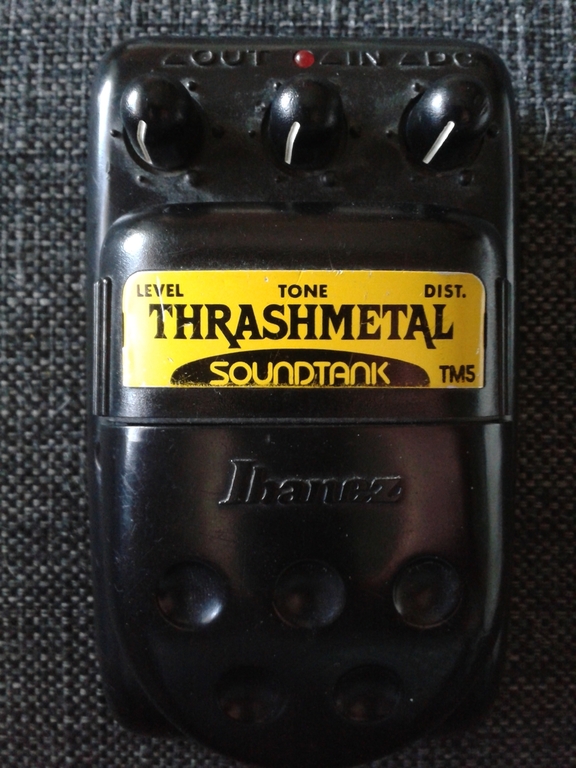
Ibanez TM5 Thrashmetal from Soundtank series in plastic enclosure, made in Taiwan around 1994-1996

Serial starting with 184 points to early-mid nineties date due to this being with its own type font. Earlier ones should be with uniform type face and so are the metal cased units. Serial is quite low for the box having its own typeface, so i’m assuming this is one of the first batches of TM5s with this font. Thrashmetal was apparently pretty popular pedal back in its day – and no wonder. It is very doog effect pedal, despite to popular disbelief that Soundtanks suck. They don’t. Period. This, like almost every tank in my collection, needed a new switch. Simple, low cost procedure which will give a new life for the box. Mods? No. This puppy won’t need any to sound good. Dirk hendrik has drawn a beautiful schematic for this. Schematic refers to metal cased unit, so there are some slight changes between later units and the first ones. Mainly the opamp used.

TM5-guts

For this unit, the opamp has 6552 413 printed on it, so it is in fact a Panasonic AN6552 – which is cited as Panasonic’s clone of NE5532 in some audio tweaker scenes. Apparently the first versions accomodated JRC4558 chips, but i strongly believe there’s no audible difference. Circuit has some details in common with Proco Rat, the main gain stage and hard clipping included. Rest of the circuit has not that much to do with a Proco design, with its discrete gain stages and active filters and other tricks. Simple, neat and very decent thing to have.

How does it sound?

Real nice. In my opinion, this is definitely one of the best designs in the whole Soundtank series. The short sustain with relatively high gain makes this circuit sound exactly like all the great bands that made 80’s thrash what it was at its best. Circuit isn’t metal in the way kids today see metal. It still offers that natural, amp-like super tight, accurate thrash sound, usually associated with 80s-90s Marshall distortions.  It may be worth mentioning that it doesn’t sound like a Rat at all. It sounds like i need to get a skateboard again.

DOD FX52 Classic Fuzz

DOD-FX52-ClassicFuzz.resized What is it?
DOD FX52 Classic Fuzz, Made in USA in early to mid 90s. Yup. It seems almost like yesterday when boxes of this series were in every young guitarists hands. It’s been 20 years already, but i wouldn’t exactly call it “vintage” for another two decades though.

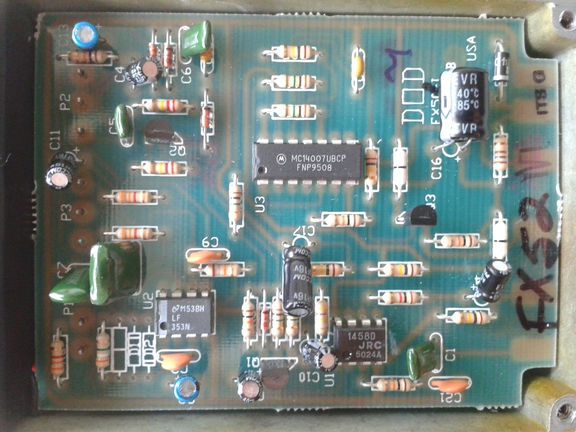
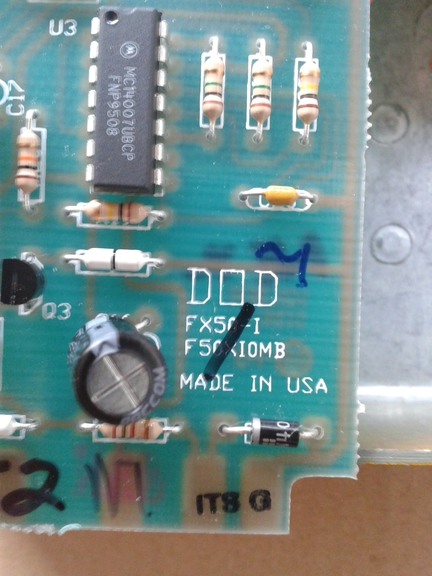
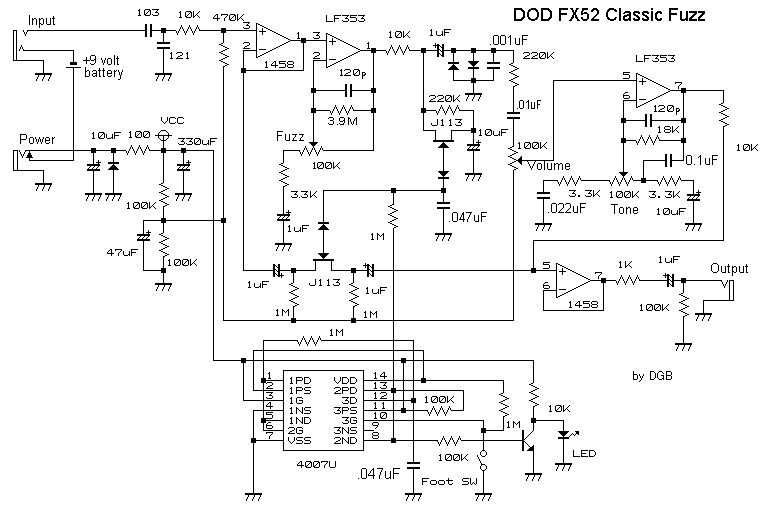
This model was discontinued in 1998, and my units serial number points to manufacture date being close to first quarter of 1994. It’s not a perfect pedal in any way. The most interesting thing is that this one has the same PCB as FX50. Only a few component values differ and one clipping stage is omitted. There’s a lot of good info available on this circuit on the America’s Pedal site. You can find the schematic hosted at Experimentalists Anonymous, if you want to see it. Schematic shows a few things one would want to mod. Not going into that right now – as i would need another unit in my collection before i would dare to ravage one of these. Things i would do to her would be; adding a diode pair to the feedback loop of LF353, tuning/upping the gain on the tone driver half of that IC and probably doubling the hard clipping diodes and removing the 1n cap taming it. One could also tune the 22n and 10µ caps to their taste of tone control. Maybe even rethink some pot values and tapers.

DOD-FX52-ClassicFuzz-Guts1.resized

Chips not affiliated with bypass switching are LF353 for the gain and tone stages and JRC1458 as in and out buffers. Also. Note the unconnected components left from LF353. As you can see from the shot above, the model is marked on the board with permanent marker. Here’s another photo that shows what’s under the filter cap:

DOD-FX52-ClassicFuzz-Guts4.resized

So it’s built on FX50 PCB. According to internet, it seems that there are other models sharing the same board too.

How does it sound?
To be honest. I’ve heard a lot of better circuit designs. Where DOD advertised this with the spiel “The FX52 Classic Fuzz duplicates the sound of the early 60s distortion boxes, such as the Fuzz Face and the Fuzz Tone. A must for musicians looking for a more nostalgic sound.” – I Do not find the resemblence to Maestro or Arbiter fuzzes mentioned. It’s more compressed than Big Muff, while that would be the closest vintage circuit. I still can’t hear the Fuzz in there. It’s much closer to being just muddy distortion than a real Classic fuzz. It has decent output level and better-than-average sustain. Might keep it in my collection, just in case. But i don’t see myself fastening this to my pedal board anytime soon. Or maybe i should mod it after all…  Good thing you can get still these for cheap, at least at the time of writing.

Newer posts »

© 2025 killall -9 humans

Theme by Anders NorenUp ↑